
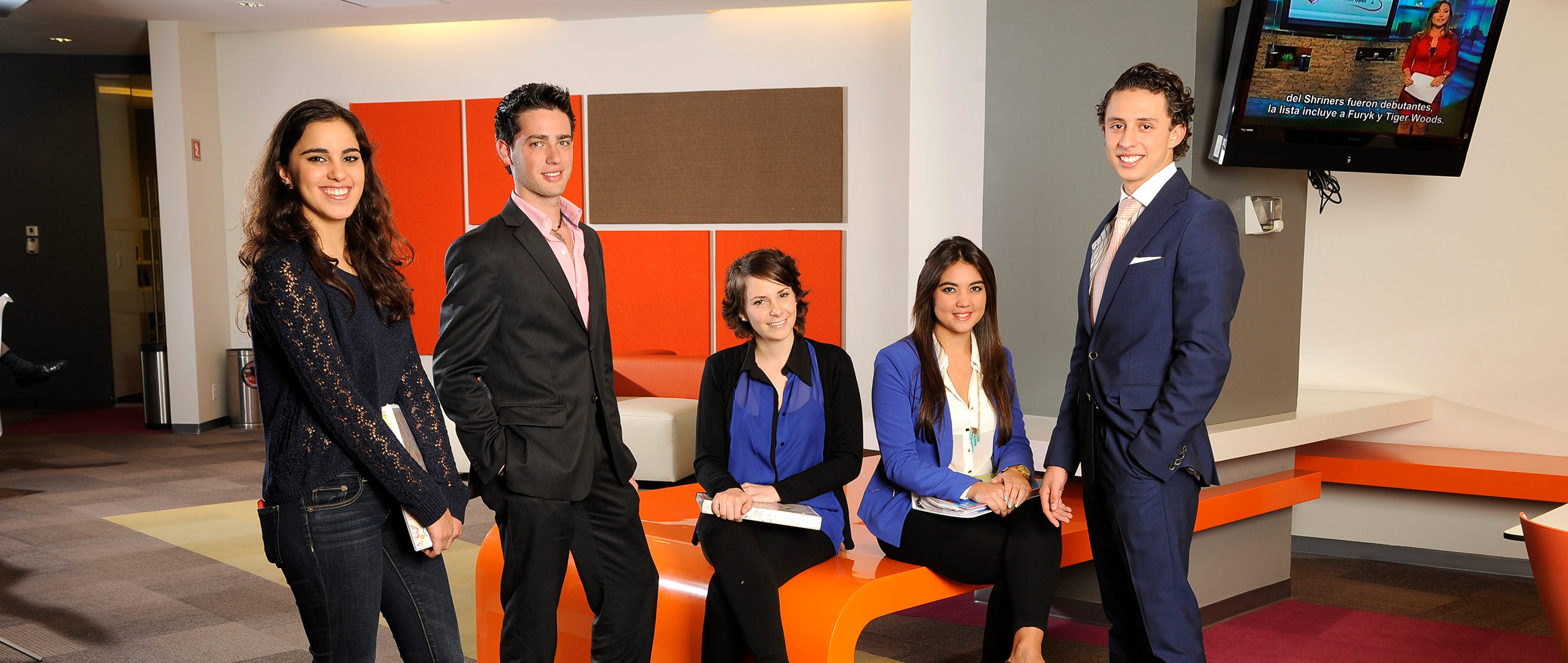

Bachelor in Management and International Business

Graduates of the Bachelor's Degree in Management and International Business will have the tools to negotiate in intercultural environments, intervening with strategies based on research and analysis of information provided by the markets, in order to design business models according to the national and international context, always directed with a high ethical sense.
Main Certifications
This program is nationally accredited by CACECA (Consejo de Acreditación en la Enseñanza de la Contaduría y Administración).
RVOE
SEP: 942063, date 09-Aug-1994
ENTRY PROFILE
Individuals who are interested in studying International Business and Management at UP should:
- Have foreign language skills.
- To be open leaders with a high sense of social responsibility.
- Be willing to generate changes in the national and international environment through professional practice based on ethics and interculturality.
GRADUATE PROFILE
Graduates of the Bachelor's Degree in Management and International Business will have the following knowledge, abilities, attitudes and skills:
Knowledge of:
- The fundamentals of human capital management and strategies for the proper corporate function.
- The elements of the financial function for resource management and analysis of results for decision making.
- The techniques to design and implement innovative and competitive marketing and logistics strategies to achieve the positioning of products and/or services in international markets.
- The elements and tools necessary to evaluate the feasibility of international projects.
- Effective strategies to carry out marketing and negotiation actions.
- The methodologies of international business in dimensions of law, economics, finance and global trade.
- The operation of customs legislation and international law for compliance with international laws.
- International agreements and treaties for understanding the global business order.
- The essential elements of the human capital area for the achievement of the objectives and the proper functioning of the organization.
- Operations, processes and mathematical tools in the company for the optimization of resources.
- The areas of operations, process analysis and marketing that will allow a high performance in the administration and management of the company.
Skills for:
- The development of national and international companies with clear goals and the capacity to make relevant decisions and generate employment.
- The development of opportunities for companies in their negotiations and potentialization of projects that contribute to the social good.
- The design and implementation of competitive strategies, elaborated with the support of information and communication technology tools.
- The creation of proposals for the development of business opportunities and innovative projects.
- The detection of business opportunities in the international arena and the ability to generate changes in their environment.
- Project evaluation.
Attitudes:
- Facing business decisions with a global vision and ethical orientation.
- Projecting oneself.
- Seek the highest degree of results in the international business functions you perform.
- Commitment to society, company and obligations assumed. Adherence to a cause.
- The application of knowledge with a high ethical-humanistic sense, as well as responsibility and solidarity towards society.
Skills for:
- Manage national and international companies with strategic bases of efficient leadership.
- Promote business mergers that benefit communities through social projects.
- Use information and communication technologies to improve the quality and transparency of the service offered and the possibilities for business development in the corresponding sector.
- Manage the opening of national and international markets for the commercial development of the company.
- History of culture
- Fundamentals of Calculus
- Strategic Management
- Financial Accounting
- Introduction to Law
- Marketing Fundamentals
- Management Workshop
- Writing and Speaking Workshop
- Person and Society
- Differential and Integral Calculus
- Business Administration
- Human Resources Management
- Control of Financial Information
- Financial Mathematics
- Fundamentals of International Business
- Ethics
- Matrix Algebra
- Cost Analysis
- Introduction to Economic Science
- Commercial Law
- Financial Analysis
- New Product Development and Innovation
- Research Workshop
- Theological Anthropology I
- Probability and Descriptive Statistics
- Development of Personal Competencies
- Budgets Microeconomics
- Labor Law Regulations
- Global Trade
- Technological Tools for Information Management
- Theological Anthropology II
- Inferential Statistics
- Business Creativity
- Macroeconomics
- International Market Intelligence
- Corporate Finance
- International Relations
- Business Internationalization
- Social Philosophy
- Operations Research
- Development of Management Competencies and Professional Practice
- Entrepreneurs
- Supply Chain Management
- Customs Legislation
- Financial Evaluation of Investment Projects
- Information Technology
- Man and the Contemporary World
- Operations Management
- International Economy
- International Logistics
- International Agreements and Treaties
- Integral Company System
- Elective
- Elective
- Professional Ethics
- Management Action Analysis
- International Negotiations
- Foreign Trade Audit
- Elective
- Elective
- Strategic Simulation
- Import and Export Project
- International Law
- Geopolitics
- Diplomacy
- Elective
- Elective

"Studying at UP was very enriching thanks to the knowledge it provides and the social relations you can establish. The job field is very broad: you can work in foreign trade as well as in diplomatic relations. I had the opportunity to go on an exchange program at Disney, which allowed me to meet people from different countries".
Brenda Mora, Aguascalientes campus.
"Studying at UP is a source of pride as it is a university where I was never just another student number; on the contrary: I had teachers and classmates who saw me as a person and I received constant support to exploit my capabilities and learn new skills."
Isabel Medrano, class of 2019, Aguascalientes campus.
Admissions