
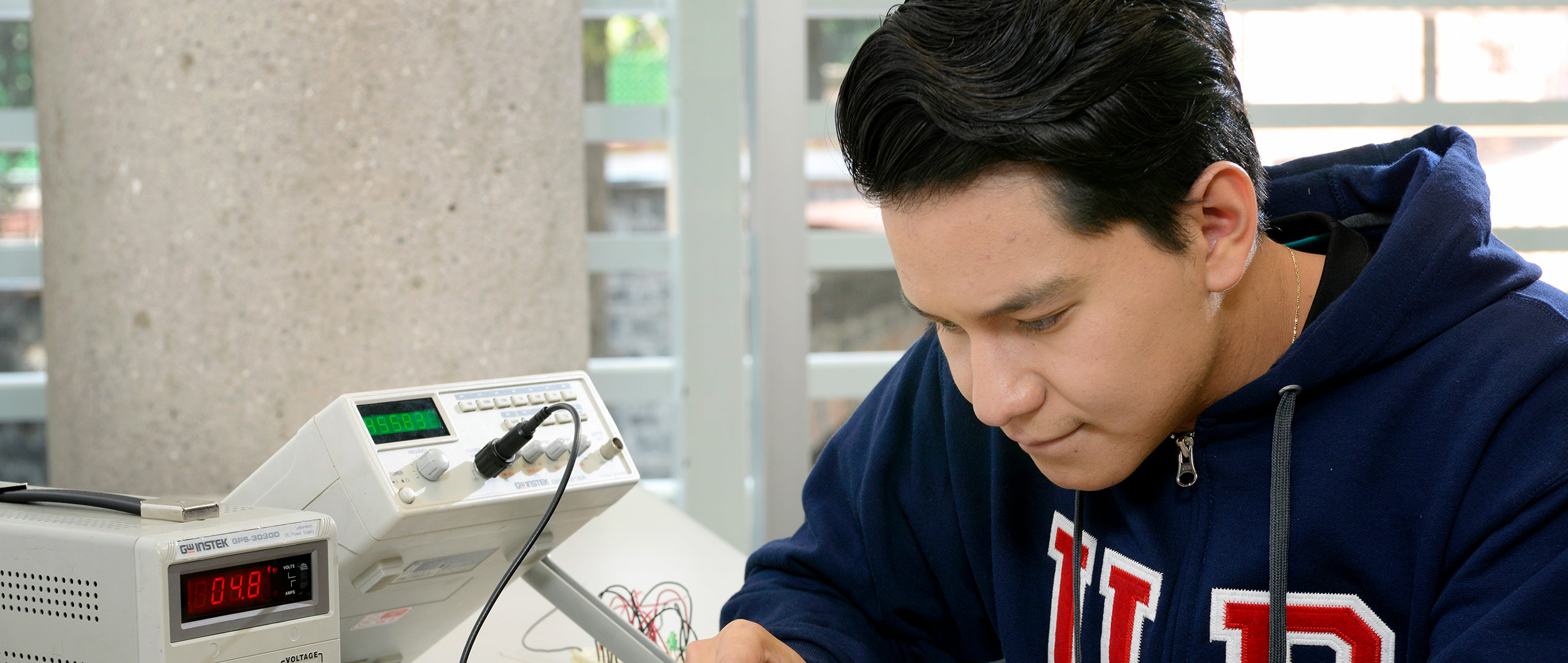
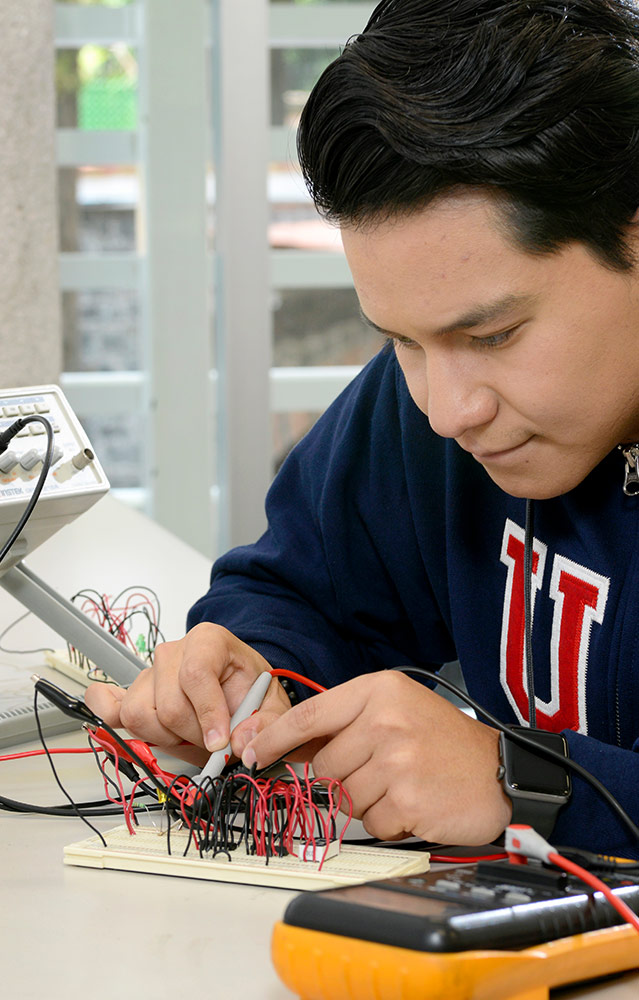
Mechatronics Engineering

We have a CACEI certification (Council for the Accreditation of Engineering Education), which endorses our professors and curriculum so that our students receive specialised academic programmes with a high level of national and international recognition.
Our mission is to train students with the criteria and knowledge that will highlight their skills in the labour field, in turn the courses will help to complement everything related to the subjects of:
- Mechanisms.
- Strength of materials.
- Machine design.
- Control systems.
- Digital control.
- Numerical control machines.
RVOE
SEP 2002005 dated 14/1/2000, plan 2017, school-based modality, Augusto Rodín campus.
ENTRY PROFILE
As a candidate for the Bachelor of Engineering in Mechatronics, you should have the following skills:
- To be creative, imaginative and inventive.
- Show interest in technology.
- Being able to work in a team.
- To develop the capacity for analysis and abstraction.
- Have an interest in mathematics and physics.
- Implement leadership and entrepreneurial vision.
- Sense of responsibility and commitment to society to improve people's quality of life.
GRADUATE PROFILE
The Educational Objectives of the Mechatronics Engineering program are focused on training:
- PEO 1. Graduates capable of positively impacting organizational results through the successful practice of Engineering.
- PEO 2. Graduates capable of making decisions and solving problems through creative and innovative ideas, as the product of critical, analytical, and systemic thinking.
- PEO 3. Graduates with leadership skills, working autonomously and in teams, in multidisciplinary, national and international contexts.
- PEO 4. Graduates who are flexible in the face of change and capable of updating their competencies through continuous learning.
- PEO 5. Graduates with a vocation for service to society and with a clear ethical orientation in all their actions.
The student outcomes for Mechatronics Engineering at the School of Engineering Mexico City Campus are:
- An ability to identify, formulate, and solve complex engineering problems by applying principles of engineering, science, and mathematics.
- An ability to apply engineering design to produce solutions that meet specified needs with consideration of public health, safety, and welfare, as well as global, cultural, social, environmental, and economic factors.
- An ability to communicate effectively with a range of audiences.
- An ability to recognize ethical and professional responsibilities in engineering situations and make informed judgments, which must consider the impact of engineering solutions in global, economic, environmental, and societal contexts.
- An ability to function effectively on a team whose members together provide leadership, create a collaborative environment, establish goals, plan tasks, and meet objectives.
- An ability to develop and conduct appropriate experimentation, analyze and interpret data, and use engineering judgment to draw conclusions.
- An ability to acquire and apply new knowledge as needed, using appropriate learning strategies.
"Mechatronics Engineering and Operations Management at UP helped me to define the course of my objectives, seeking to simplify and continuously challenge the processes of the industry I am part of today, without leaving aside my values in each of the actions I take. In addition to having met people who are now a big part of my life.
Gabriel Alejandro Scott Arellano, 2013-2018, Mexico City Campus
"Daring to study Mechatronics Engineering has been one of my greatest prides. I trained my mind to exhaustion through physics and mathematics, and today I can better understand and appreciate our world. I lived with very valuable people, students and teachers, who have left their mark and to this day are important factors for my constant growth."
José Antonio Ochoa, 2000-2005, Mexico Campus
"Studying Mechatronics Engineering at Universidad Panamericana has been a decision that to this day has helped me to prepare myself in a human and professional way. It taught me to work with other people, to be responsible, to respect and the importance of perseverance. It also provided me with knowledge that has helped me to develop professionally and continue to grow. In addition, I was able to meet people who have enriched me and formed me as a person that today I continue to learn from them."
José Luis Rangel Pérez 2013-2018 Mixcoac branch.
Admissions