

Admission test
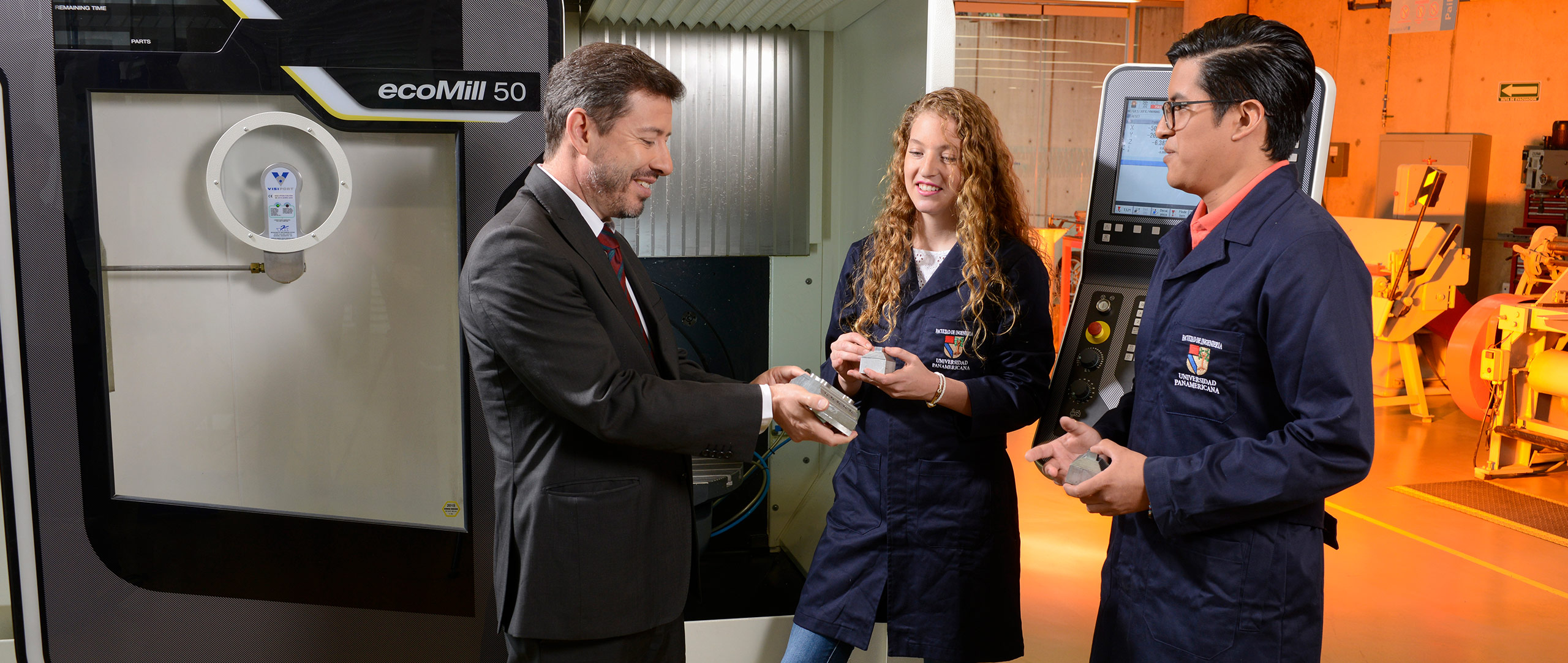
Civil Engineering and Administration
The civil engineer and administrator of Universidad Panamericana is capable of developing projects with a sustainable approach and quality of life for the surrounding society, exercising his profession in an ethical, competent and collaborative manner.
In Civil Engineering and Administration we plan, design, construct, maintain and operate the building and infrastructure required by society, through the advanced use of technology for the public and private sectors.
What are the advantages of our programme?
- We have a graduate profile that includes civil engineering plus administration.
- We are the most advanced curriculum in the application of BIM methodology, thanks to the advanced application of cutting-edge technologies applicable to the construction industry.
- We have a double degree program at one of the best universities in the United States: Civil Engineering and Management with a Master's Degree at the University of Illinois (TOP 3 in the United States).
- We have postgraduate agreements with ZIGURAT, one of the most important institutes in relation to BIM methodology worldwide.
- The vast majority of our graduates finish their degree with a job or an entrepreneurial project.
Undergraduate sites Civil Engineering and Administration
- Guadalajara
- Aguascalientes
RVOE
871472, dated October 2017.
Admission Profile
We are looking for people who stand out for their high sense of social responsibility and love for mathematics, physics, design and digital modeling.
- Search for improvement of the environment in which we operate
- Analytical and synthetic skills
- Creativity.
- Interest in new technologies.
- Determination to undertake tasks.
- Leadership and teamwork skills.
- Sense of social responsibility.
- High standards.
Graduate Profile
As a graduate in Civil Engineering and Administration from Universidad Panamericana, you will stand out for your ability to analyze and solve Civil Engineering problems. In addition, you will have the following knowledge and skills:
- Management and development of infrastructure projects applying the BIM Methodology.
- Operations research and programming.
- Analysis of geotechnical projects.
- Development and management of information associated with hydrosanitary infrastructure, applying knowledge of hydraulics and hydrology.
- Design of concrete and steel structures.
- Project planning, construction and control.
- Professional ethics.
In addition, you will be able to:
- Formulate an infrastructure project plan.
- Organize and direct the efforts of a work group.
- Develop budgets applied to construction, considering current market requirements.
You will be characterised by:
- Possess a strong vocation for service.
- Determination to undertake.
- Self-maturity and openness to change.
- Have the capacity for self-learning and constant updating.
- Willingness to work in a multidisciplinary team.
- Handling of software updated to the new market requirements with the BIM methodology.
First Semester
- Differential Calculus
- Algebra * Algebra * Algebra * Algebra * Algebra * Algebra * Algebra * Algebra * Algebra
- Physics * Physics * Physics * Physics * Physics * Physics * Physics * Physics * Physics
- CAD Applied to Civil Engineering
- Introduction to Civil Engineering
- Programming for Civil Engineering
- History of Culture*.
Second Semester
- Integral Calculus
- Linear Algebra * Linear Algebra * Linear Algebra * Linear Algebra * Linear Algebra * Linear Algebra
- Static
- Topography
- Design for Civil Engineering
- Person and Society * Person and Society * Person and Society * Person and Society * Person and Society * Person and Society * Person and Society
Third semester
- Vector Calculus
- Dynamic *
- Isostatic Structures
- Information Systems
- Fundamentals of Intelligent Control
- Ethics * Ethics * Ethics * Ethics * Ethics * Ethics * Ethics * Ethics * Ethics * Ethics * Ethics * Ethics * Ethics
Fourth semester
- Materials and Construction Processes
- Differential Equations
- Probability and Statistics
- Mechanics of Materials
- Introduction to Administration
- Alternative Energies * Alternative Energies * Alternative Energies * Alternative Energies * Alternative Energies * Alternative Energies * Alternative Energies *
- Theological Anthropology I * Theological Anthropology I
Fifth semester
- Geology
- Fundamentals of Hydraulics
- Concrete Technology
- Unit Costs
- Building and Infrastructure Budgets
- Open Channel Hydraulics
- Environmental Impact
- Theological Anthropology II
Sixth semester
- Soil Properties
- Structural Analysis
- Material Behavior
- Project Planning and Control
- Drinking Water and Sewerage
- Social Philosophy
Seventh semester
- Soil Mechanics
- Design of Steel Structures I
- Design of Concrete Structures I
- BIM Model Creation
- Land Roads
- Earthquake Engineering
- Man and the Contemporary World *.
Eighth semester
- Installations in Buildings
- Accounting and Costs
- Design of Steel Structures II
- Design of Concrete Structures II
- BIM Work Planning
- Foundation Engineering
- Professional ethics * Professional ethics * Professional ethics * Professional ethics * Professional ethics * Professional ethics * Professional ethics * Professional ethics * Professional ethics
Ninth Semester
- BIM Integral Construction
- Structures Workshop
- Evaluation of New Technologies for Construction
- Hydrology
- Investment Projects and Introduction to Business Valuation *.
Tenth semester
- Financial Evaluation of Projects
- Pavement design
- Urbótica
- Energy and environmental certification of buildings
- Project risk management
- Value Engineering of Construction Projects
- Hydraulic Works
International Exchanges
Germany: Albstadt-Sigmaringen University of Applied Sciences, Albstadt
Canada: Université de Moncton, New Brunswick; Mount Royal University, Alberta
Colombia: Pontifical Bolivarian University, Medellín
Spain: Catholic University "San Antonio de Murcia"; University of Burgos; University of Oviedo; University of Salamanca; University of Santiago de Compostela; Polytechnic University of Madrid.
France: École Nationale d'Ingénieurs de Tarbes; École Supérieure des Technologies Industrielles Avancées (ESTIA), Bidart
Italy: Politecnico di Milano
Taiwan: Chaoyang University of Technology
Uruguay: University of Montevideo
Brazil: Veiga de Almeida University, Rio de Janeiro; Pontifical Catholic University of Rio de Janeiro
Chile: Universidad de los Andes, Santiago; Universidad Mayor, Santiago
South Korea: Korea University, Seoul
United States: California State University, Fullerton; Columbia University, New York; New York Institute of Technology (NYIT); University of Minnesota, Duluth; University of New Orleans
England: University of Nottingham; University of Southampton
Peru: "Santo Toribio de Mogrovejo" Catholic University, Chiclayo; University of Piura
Turkey: Istanbul Aydin University.
Forms of Qualification
- General Knowledge Examination (EGEL Mode)
- Thesis
- Graduate Credits