

Admission test
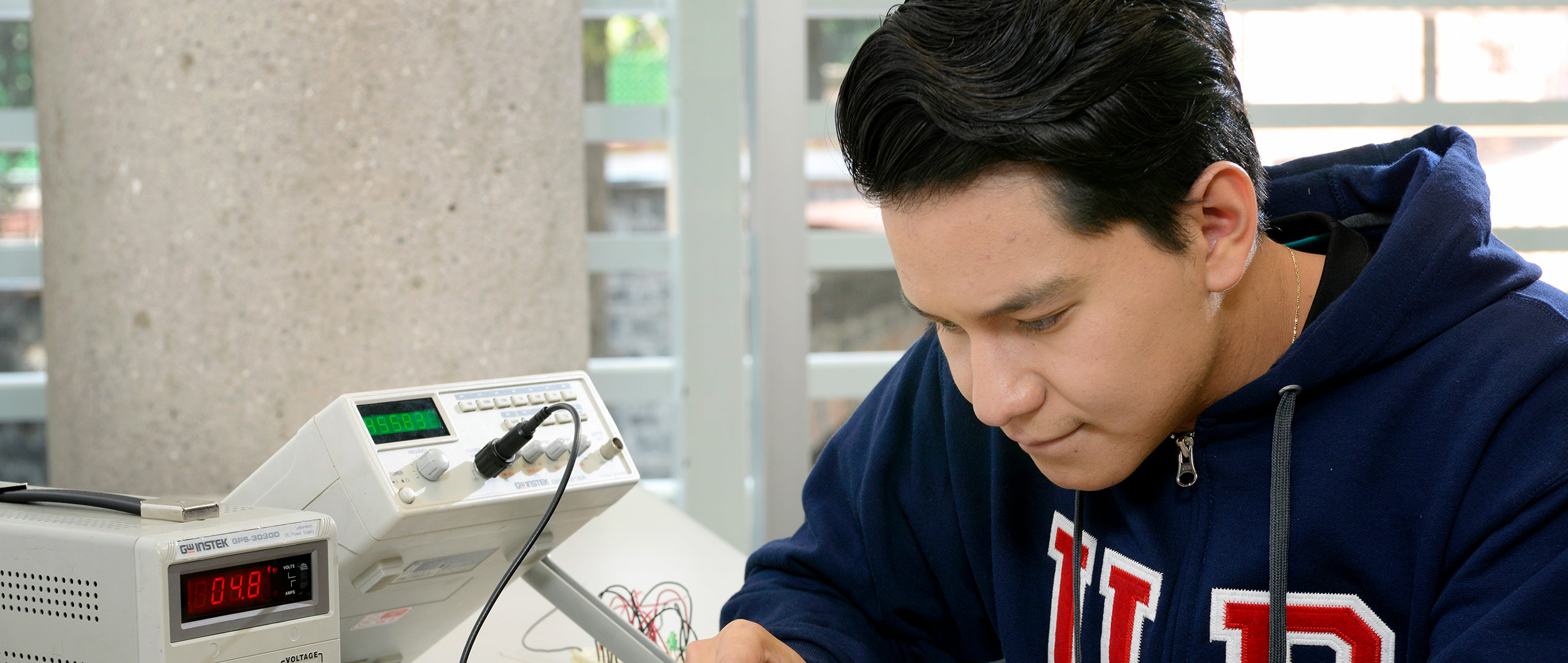
Mechatronics Engineering
Mechatronics Engineering consists of four main pillars: mechanics, electronics, programming and control. These four bases enable our graduates to make decisions and solve problems through creative and innovative ideas, product of critical, analytical and systematic thinking.
Mechatronics engineers can work in areas such as automation, automotive, aeronautics, aerospace, human assistance devices, manufacturing, etc.
Mechatronics engineering degree programmes
- Mexico City
- Guadalajara
- Aguascalientes
RVOE
2012288 , dated October 14, 2002
Admission Profile
An aspirant to study Mechatronics Engineering should have aspiration to improve society and industry through the development and implementation of technology.
Its main features are:
- Programming.
- Mathematical problem solving.
- Analytical skills.
- Reading comprehension.
- Abstract thinking.
- Correct oral and written expression.
- Logical-mechanical reasoning.
- A spirit of curiosity and creativity.
- Interest in studying.
- Interest in developing and implementing technologies
Graduate Profile
A graduate of Mechatronics Engineering from Universidad Panamericana is able to design, build and implement mechatronic products and systems to meet emerging needs, generate solutions based on creativity, innovation and continuous improvement of control systems and automation of industrial processes, support the competitiveness of enterprises through process automation, as well as evaluate, select and integrate mechatronic devices and machines, such as:
- Robots.
- Numerical control machines.
- Programmable Logic Controllers.
- Industrial computers.
You will have the skills to:
- Apply knowledge of mathematics, science and engineering.
- Design and conduct experiments.
- Analyse and interpret data.
- Draw conclusions through engineering judgement.
- Apply, analyse and synthesise mechatronic engineering design processes.
- Design a system, component or process.
- Working in multidisciplinary teams.
- Project management.
- Identify, formulate and solve mechatronic engineering problems.
- Locate, evaluate, integrate and apply knowledge appropriately.
You will have the following attitudes:
- Recognise ethical and professional responsibility.
- To build their own life project with a clear ethical orientation in their actions.
- Updating competences through self-learning.
- Tenacity and perseverance.
Labor Field
Due to the fact that it combines several engineering fields in one, its strength is its versatility, so it can work in any area of the industry, such as:
- Automotive
- Aeronautics
- Aerospace
- Metal-mechanics
- Material design
- Maintenance of elements
- Robotics
First Semester
- History of culture*.
- Differential Calculus
- Algebra * Algebra * Algebra * Algebra * Algebra * Algebra * Algebra * Algebra * Algebra
- Editorial staff *
- Physics * Physics * Physics * Physics * Physics * Physics * Physics * Physics * Physics
- Computer Aided Design * Computer Aided Design * Computer Aided Design * Computer Aided Design * Computer Aided Design * Computer Aided Design
- Algorithm analysis and design
- Logical design
Second Semester
- Person and Society * Person and Society * Person and Society * Person and Society * Person and Society * Person and Society * Person and Society
- Integral calculus* * Integral calculus * Integral calculus * Integral calculus * Integral calculus
- Linear Algebra * Linear Algebra * Linear Algebra * Linear Algebra * Linear Algebra
- Chemistry * Chemistry * Chemistry * Chemistry * Chemistry * Chemistry * Chemistry * Chemistry * Chemistry * Chemistry * Chemistry * Chemistry
- Economic environment
- Electricity and magnetism
- Object-Oriented Programming * Object-Oriented Programming * Object-Oriented Programming * Object-Oriented Programming * Object-Oriented Programming
Third semester
- Ethics * Ethics * Ethics * Ethics * Ethics * Ethics * Ethics * Ethics * Ethics * Ethics * Ethics * Ethics * Ethics
- Static
- Vector Calculus *
- Differential equations
- Thermodynamics * Thermodynamics
- Digital systems
Fourth semester
- Theological Anthropology I * Theological Anthropology I
- Numerical methods
- Probability and statistics
- Dynamic *
- Advanced Mathematics
- Electrical circuits
- Microcontrollers
Fifth semester
- Theological Anthropology II
- Embedded systems
- Electronics I
- Mechanisms
- Strength of materials
- Dynamics of physical systems
- Quality management (optional subject)
- Electrical machines (elective)
Sixth semester
- Social philosophy
- Manufacturing processes *
- Investment projects and introduction to business valuation*.
- Design of machine elements
- Materials technology
- Control systems
- Information systems * (optional subject)
- Electronics II (elective)
Seventh semester
- Man and the contemporary world *.
- Digital control
- Mechatronic project I
- Machine design
- Hydraulic and pneumatic systems
- Programmable logic controller
- Advanced electronic circuits (elective)
- Topics in industrial installations * (optional subject)
Eighth semester
- Professional ethics * Professional ethics * Professional ethics * Professional ethics * Professional ethics * Professional ethics * Professional ethics * Professional ethics * Professional ethics
- Operations management
- Environmental improvement systems
- Mechatronic project II
- Computer-aided manufacturing
- Power electronics
- Industrial robotics (elective)
- Digital Signal Processing (elective)
- Business management * (optional subject)
International Exchanges
Germany, FH Schmalkalden
Austria, University of Applied Sciences Wiener Neustadt
Canada, Mount Royal University, Alberta
Colombia, Institución Universitaria de Envigado
Denmark, University of Southern Denmark, Odense M.
Australia, Macquarie University, Sydney.
Canada, Université de Moncton, New Brunswick
Chile, Universidad Mayor, Santiago
Colombia, Universidad Pontificia Bolivariana, Medellín
Spain, University of Burgos
Spain, University of Navarra
Spain, Universidad de Nebrija, Madrid
Spain, University of Salamanca
United States, New York Institute of Technology (NYIT)
France, L’Ecole Supérieure des Technologies Industrielles Avancées (ESTIA), Bidart
Spain, School of Engineering (TECNUN), San Sebastián
Spain, University of Oviedo
Spain, Polytechnic University of Valencia
France, École Nationale d’Ingénieurs de Tarbes
Indonesia, Universitas Surabaya
England, University of Nottingham
Italy, Politecnico di Milano
Peru, University of Piura
Turkey, Istanbul Aydin University
England, University of Southampton
Peru, Universidad Católica Santo Toribio de Mogrovejo, Chiclayo
Taiwan, Chaoyang University of Technology
Being aware of the importance of providing our students with a broader vision of the world around them, we have the following agreements in different countries.
Forms of Qualification
- Graduate Credits, 4+1 Track
- 4 years of study plus 1 year of Specialization