In 2021, the National Council of Science and Technology (CONACYT, for its Spanish acronym) issued a call for proposals for the project “Basic and/or Frontier Science: Paradigms and Controversies.” It supports researchers’ evaluations of paradigms, hypotheses, and theories that advance our understanding of phenomena in various fields of knowledge, and provides funding for projects that aim to analyze open-access data (online) to offer a novel scientific perspective.
Rodrigo Sosa Sánchez, who holds a Ph.D. in Behavioral Science from the School of Pedagogy and Psychology at the Universidad Panamericana, Guadalajara campus, with the support of Dr. Emmanuel Alcalá from the Western Institute of Technology and Higher Education (Instituto Tecnológico y de Estudios Superiores de Occidente, ITESO) and Jonathan J. Buriticá, Associate Professor at the Center for Behavioral Studies and Research (Centro de Estudios e Investigaciones en Comportamiento, CEIC), set out to participate in this call with a project on time estimation.
Time Estimate
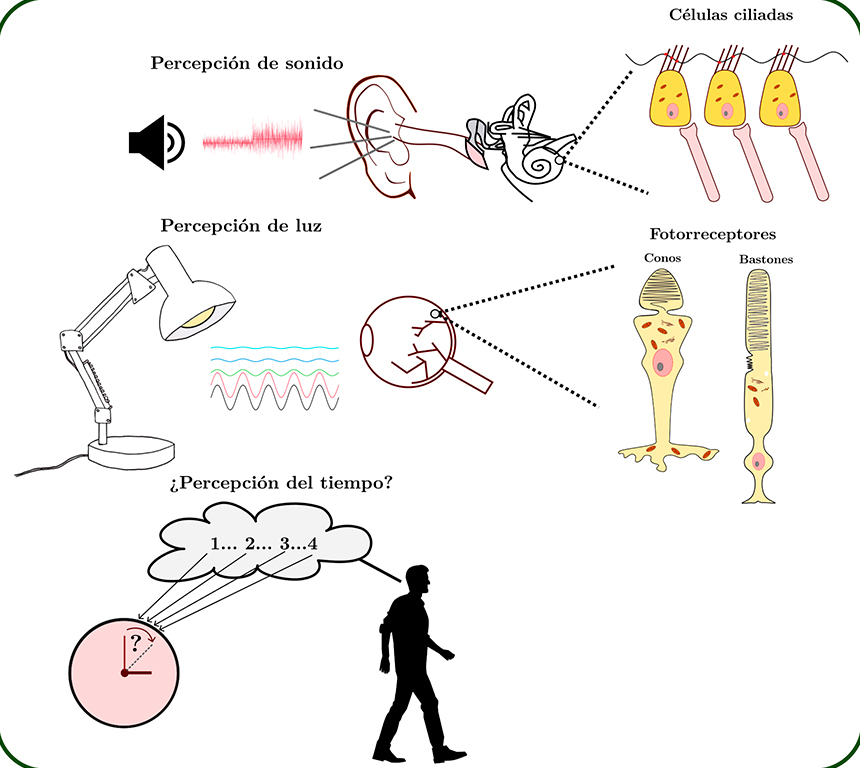
Time estimation (or interval estimation) is a psychological phenomenon that refers to the ability to structure our behavior according to the temporal patterns of our environment.
For many authors, this is an intriguing phenomenon because, biologically speaking, we have receptors that detect light, sound, textures, and even chemicals, allowing us to adapt to our environment, but we lack specific receptors to detect the passage of time.
How do we estimate the duration of intervals? The short answer is that we have certain “pacemakers” in our nervous system that allow us to estimate (with a certain degree of error) the “when” of events occurring around us.
Our own behaviors sometimes also serve as pacemakers to signal the right time to act; this is because we also have receptors that detect the immediate consequences of our actions.
How do we estimate time?
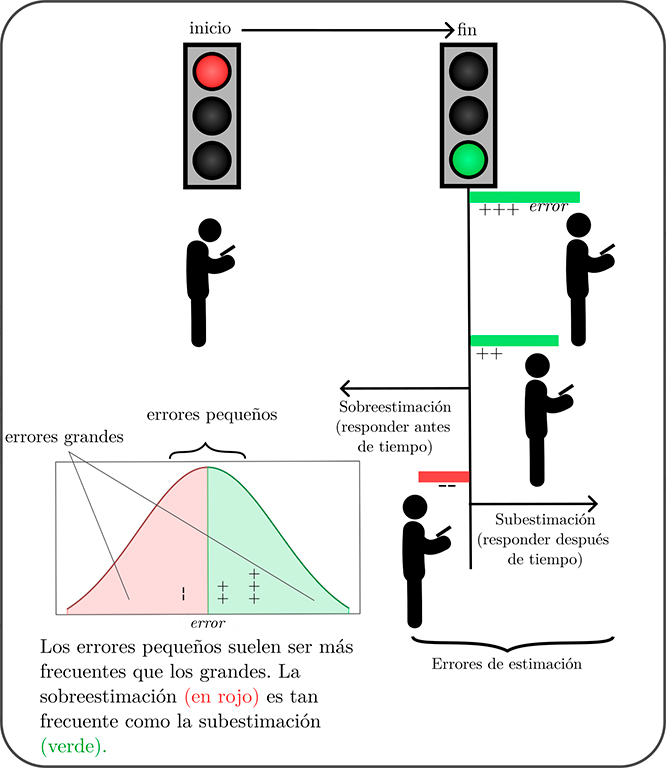
Dr. Sosa Sánchez explains that our ability to estimate time is involved in virtually every aspect of our lives. For example, when driving home, we regularly stop at an intersection when the traffic light is red. If we assume that the duration of the red light is constant, then this is a learning opportunity (we learn from the patterns in our environment).
In such a situation, to act effectively, we need to follow a sequence of two actions: (1) checking to see if the light has turned green, and then (2) pressing the gas pedal to continue on our way home. What do we do while waiting for the light to change from red to green? People do a variety of things, but the point is that, almost without exception, we will eventually look at the traffic light to see if it’s time to step on the gas or if we should wait a little longer.
“The interesting thing is that, as we learn, our errors are probably distributed like a Gaussian bell curve,” explains Dr. Sosa. That is, sometimes when we look at the traffic light, it may have already turned green (we underestimate the passage of time) or it may be a fraction of a second away from turning green (we overestimate the passage of time).
The purpose of the project
The spirit of this project, in Dr. Sosa’s words, is to describe the error correction mechanisms involved in order to obtain a more accurate estimate of the intervals we regularly encounter. For example, if we take longer to turn and look at the traffic light, the driver behind us might honk at us, and we might be startled by the sudden noise. Or, conversely, if we look too soon, we interrupt the leisure activity or daydream that was occupying us while the light was red.
According to Dr. Sosa, the specific objective is to study the organization of behavior beyond the point at which learning has already been completed—which is what has been studied in greater depth.
Specifically, the researchers are interested in uncovering the microstructure of learning through error correction and the individual differences in the propensity to learn from these temporal regularities. That is, the moment-to-moment adjustments that individuals make to adapt to the temporal attributes of their environment, as well as the persistent individual traits that distinguish specific individuals.
Support Received
Dr. Sosa explains that his CONACYT project involves achieving a series of outcomes, including publishing a scientific article featuring data analysis, participating in conferences and workshops, and establishing a repository with digital tools for the analysis of behavioral data (see https://github.com/jealcalat/YEAB).
At the same time, the Universidad Panamericana is supporting this project by providing office space for Dr. Emmanuel Alcalá, an associate researcher who is now the project leader, as well as organizing one of the conferences included in the scientific dissemination plan.
Contributing to our understanding of behavior
Similarly, Dr. Sosa states that“the commitment to contributing to our understanding of behavior is what led us to conduct this research, since, on many occasions, one must take a step back and take the time to think about things differently—usually in an abstract and formalized way.”
“This is a basic science research project—that is, science that lays the foundations for any field of knowledge, providing us with the principles on which to build a coherent body of knowledge and reduce our uncertainty about the universe around us,” he says.
He also points out that, in contrast,“frontier science or applied science proposes strategies for addressing the phenomenon under study in relation to a problem in today’s world. Although the latter attracts a great deal of attention, it is important to emphasize that applied science cannot exist without robust basic science.”
“For the time being, we cannot jump to conclusions about the results, since the project will involve decomposing the variance in time-series estimation data from several individuals using hierarchies based on the units of analysis—moment-to-moment observations within a day or across days,” he states.
He also concludes that, “Broadly speaking, one would expect to find certain patterns in how behavior is structured given temporal constraints. It will be interesting to determine which of the above factors accounts for a larger proportion of the variance. In addition, we will identify what proportion of the variance falls outside the scope of the proposed factors—that is, how much noise there is in the data.”
Research team
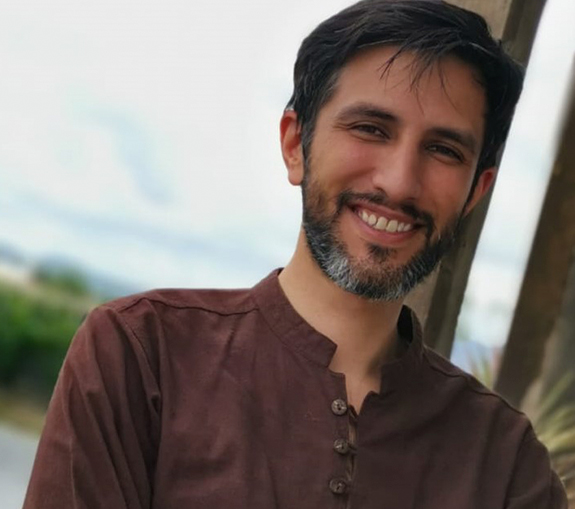
Dr. Rodrigo Sosa Sánchez, Lead Researcher
Doctor of Behavioral Science, Level B Research Professor in the School of Pedagogy and Psychology, SNI Level I
UP Guadalajara Campus
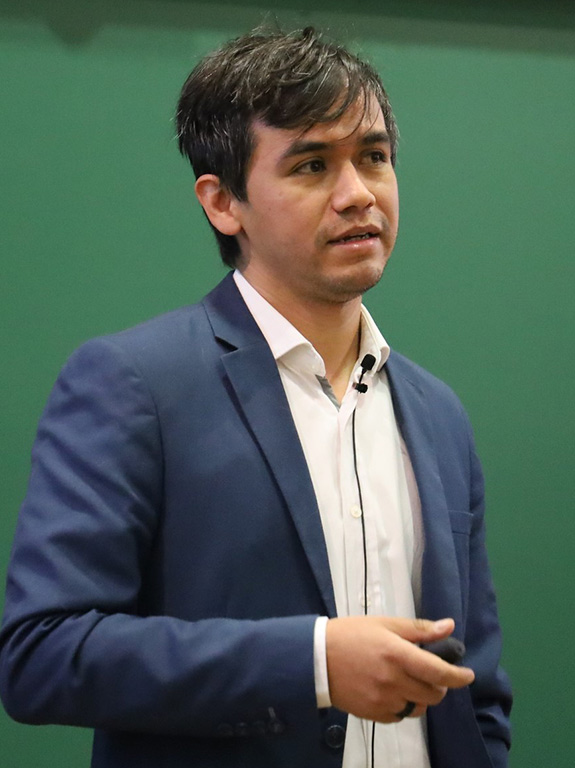
Dr. Emmanuel Alcalá, Associate Researcher
Doctor of Behavioral Science, Professor in the Department of Mathematics and Physics, SNI Candidate
Western Institute of Technology and Higher Education (ITESO)

Dr. Jonathan J. Buriticá Buriticá, External Collaborator
Ph.D. in Behavioral Science, Associate Professor at the Center for Behavioral Studies and Research (CEIC), SNI Level I
University of Guadalajara