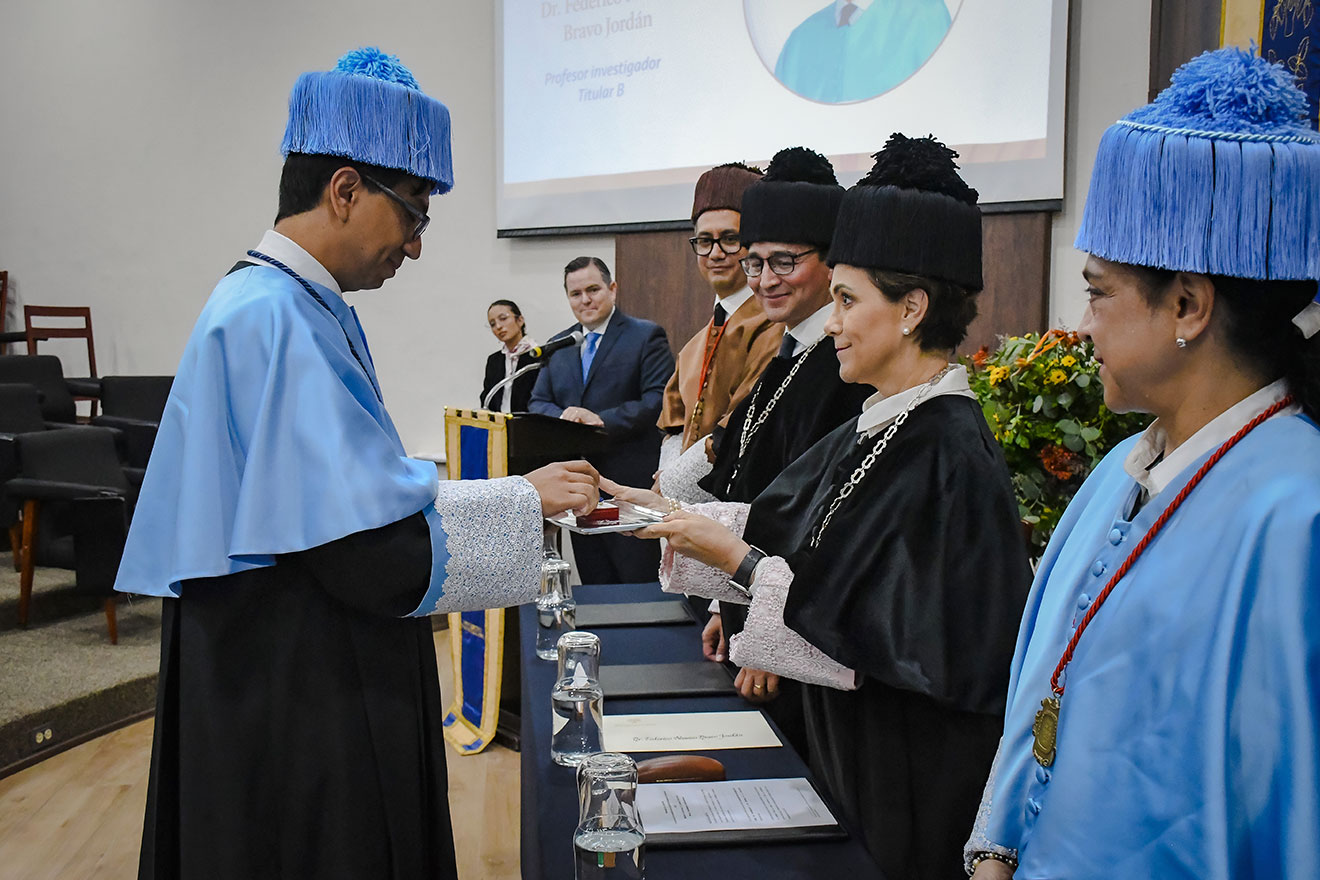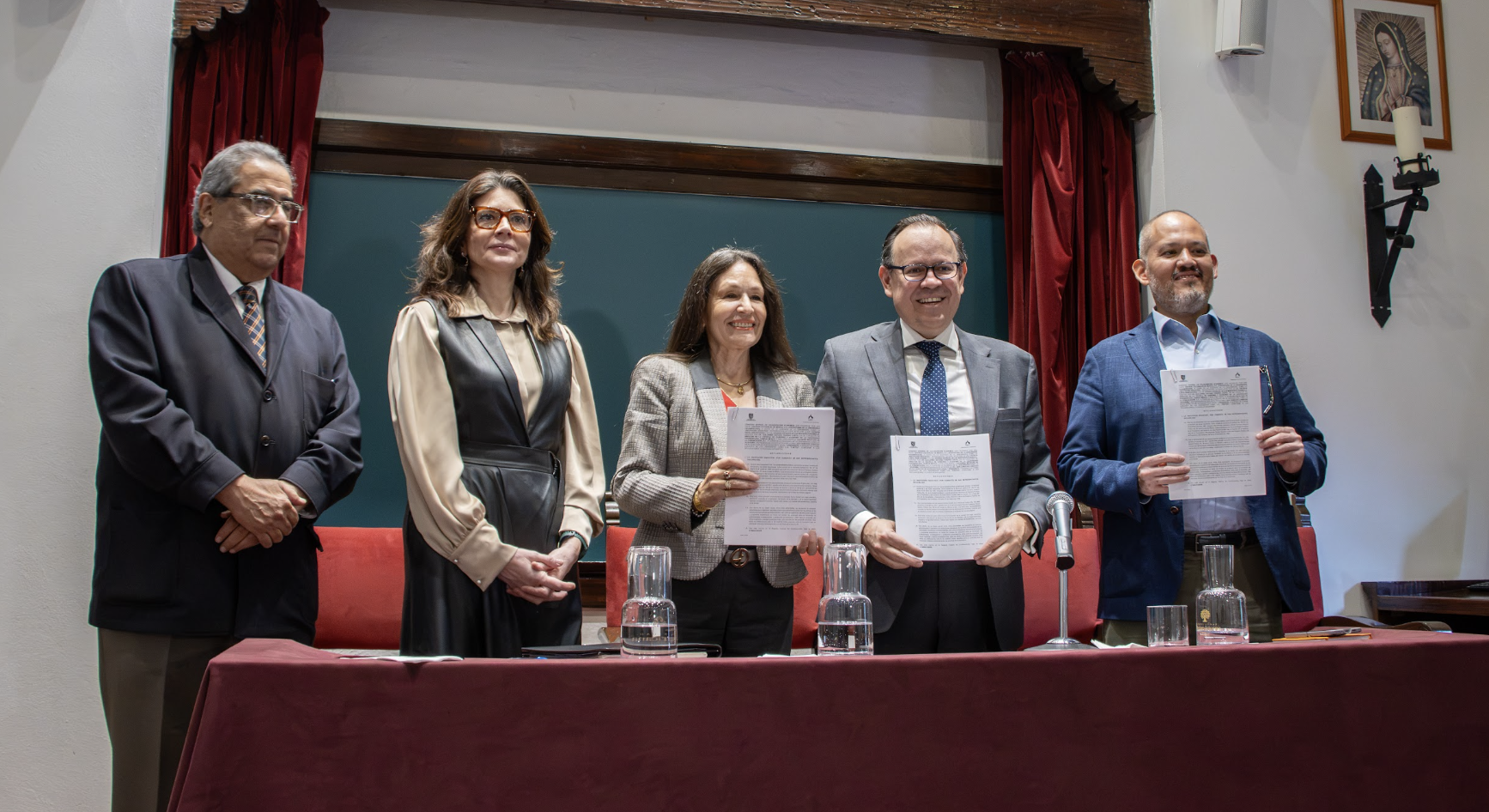
Zapopan, Jalisco; December 11, 2025.— The Universidad Panamericana celebrates a new achievement in the field of science and technology: Dr. Fidencio Tapia, a professor and researcher in the School of Engineering, was awarded the 2025 National Innovation Award by the Mexican Institute of Industrial Property (IMPI) in the Aeronautics and Electromobility category.
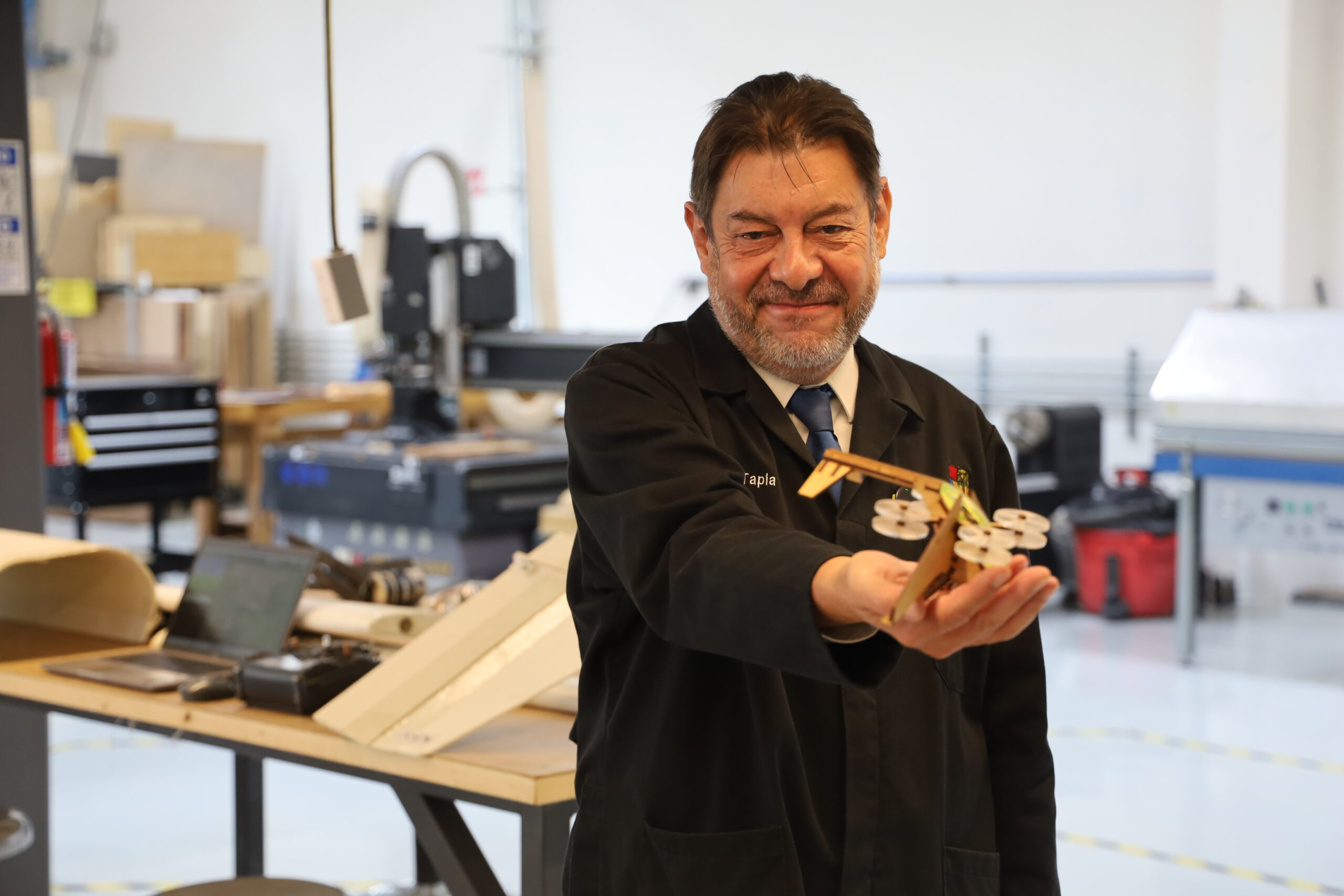
The award recognizes the creation of AKXO, a pioneering aircraft that combines the functionality of a drone with the range of an airplane, developed and patented by Dr. Tapia and his research team.
From a global challenge to a Mexican patent
The project’s origins date back to 2017, when Boeing launched the international GoFly competition, which aimed to design a lightweight, efficient aircraft for short-distance personal transportation. Although no participating team won the challenge, the experience inspired Dr. Tapia to continue his research until he established AKXO, now recognized as one of the country’s most promising innovations.
The design was selected from more than 3,700 entries in the IMPI competition, standing out for its advanced engineering and focus on energy efficiency. AKXO is based on a “tilt-wing” system, featuring eight motors and propellers that enable vertical takeoff and landing, followed by a transition to horizontal flight, significantly reducing energy consumption.
Technological innovation with a focus on sustainability
The core concept behind AKXO is a convertible aircraft, a design known as tilt-wing, where the wing rotates. Dr. Tapia explains how it works: “We have these eight motors arranged in an X shape, similar to a typical drone. We have propellers at each corner, eight motors, and the wing is vertical. It takes off, and at a certain altitude we make the transition—as we call it. We convert it into an airplane.”
The reason behind this conversion is energy efficiency. “Why don’t we want it to be a drone all the time? Because the battery doesn’t last very long, ” explains Dr. Tapia. When transitioning to airplane mode, the wing becomes the element that supports the aircraft’s weight, rather than relying on the constant thrust of the propellers.
“During level flight, the propellers no longer provide lift but instead generate forward thrust. In this way, wesignificantly reduce energy consumption,” he explains.
This innovation— the ability of an aerial vehicle to transform from a drone into an airplane and operate in a hybrid mode depending on flight conditions—is precisely the concept that was patented.
This patent, granted in 2024 and registered in the name of the Universidad Panamericana, represents more than four years of work and institutional support from the Intellectual Property Management Center and the General Directorate of Technology.

Education, innovation, and interdisciplinary collaboration
Dr. Tapia’s team—comprising Dr. Leticia Gaitán Hernández Magro, Ulises Montiel Pichardo, Moisés Arturo Barajas Maraveles, Luis Alberto Barroso Moreno, and Ignacio Turrubiartes Alvarado—embodies the spirit of academic collaboration that drives the Universidad Panamericana.
“This project is an invitation to anyone who wants to join. It’s not just about engineering; it also involves business, sociology, and the humanities. It’s an educational opportunity that allows us to teach students the value of teamwork, innovation, and achieving real goals,” says the researcher.
The purpose of the patent is not only to protect intellectual property but also to license the technology. The idea is to partner with companies that have the capability to build and market these aircraft.
A life's work that inspires the future
Dr. Tapia’s passion for aeronautics began during his high school years. After earning his master’s and doctoral degrees at Georgia Tech, he returned to Mexico in 1998, driven by a deep commitment to his country and a desire to devote himself to teaching.
“I felt completely committed to returning,” says Dr. Tapia, who, nearing retirement, plans to continue devoting his time and expertise to the development of this project, which he considers his greatest professional legacy.
Beyond the award, the researcher from the Universidad Panamericana AKXO as a lifelong project and an example of the potential of Mexican talent. His vision is to develop autonomous aircraft that can be used for urban mobility, rescue operations, or automated personal transportation.
“This is going to change the culture and architecture of cities. We’ll need new regulations and a technological ecosystem capable of integrating hundreds of smart aircraft,” he says.
With this recognition, the Universidad Panamericana reaffirms its leadership in technological innovation and scientific development, promoting projects with social and sustainable impact that showcase Mexican talent on the international stage.
Learn more about our university's research projects at: https://www.up.edu.mx/investigacion-noticias/