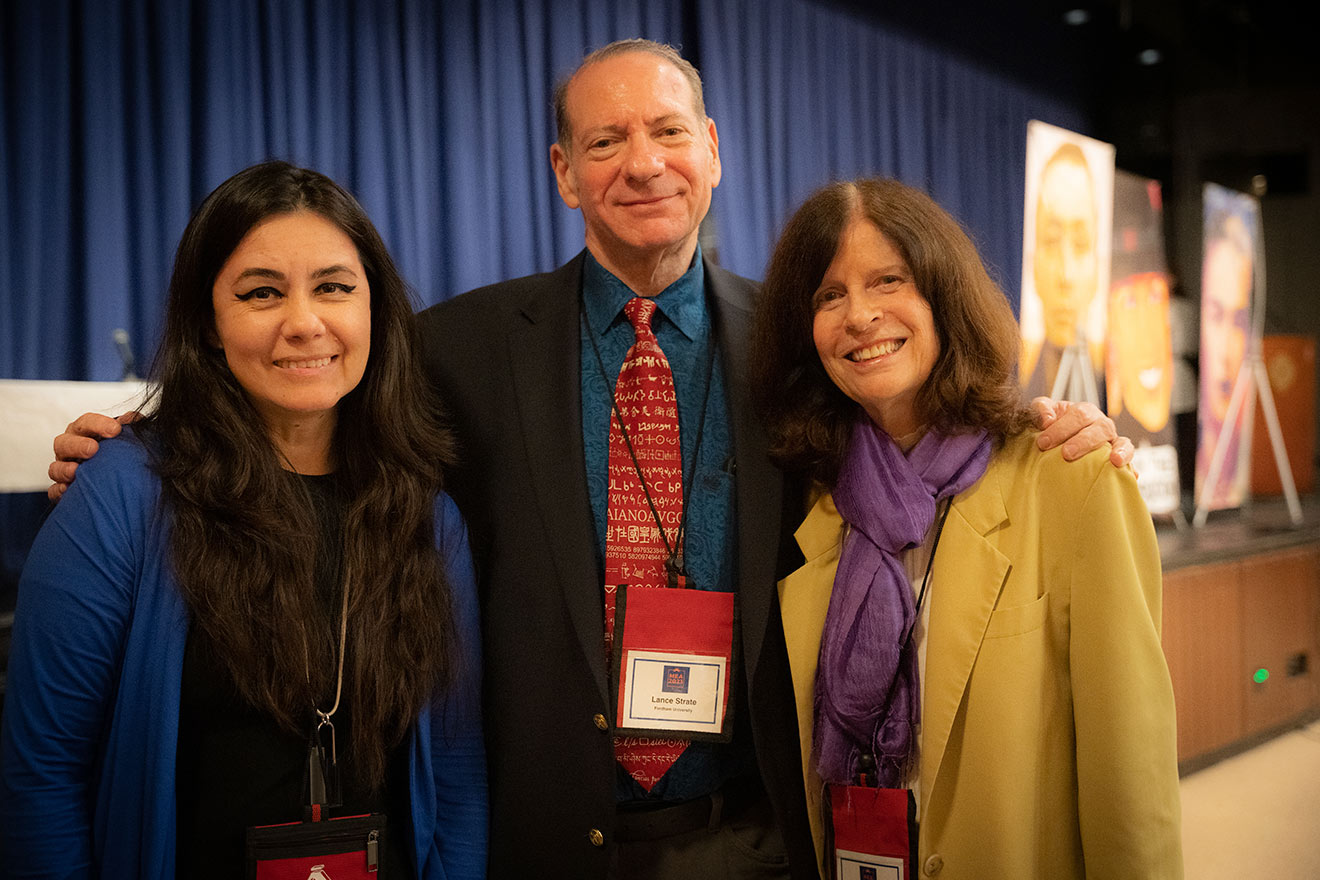
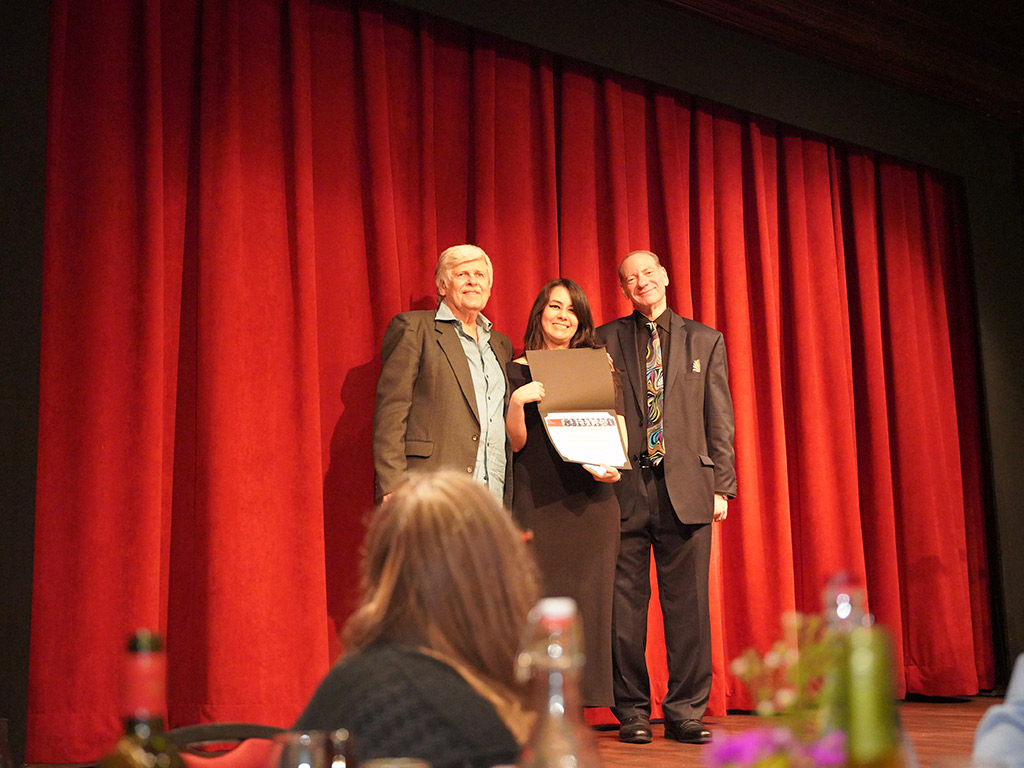
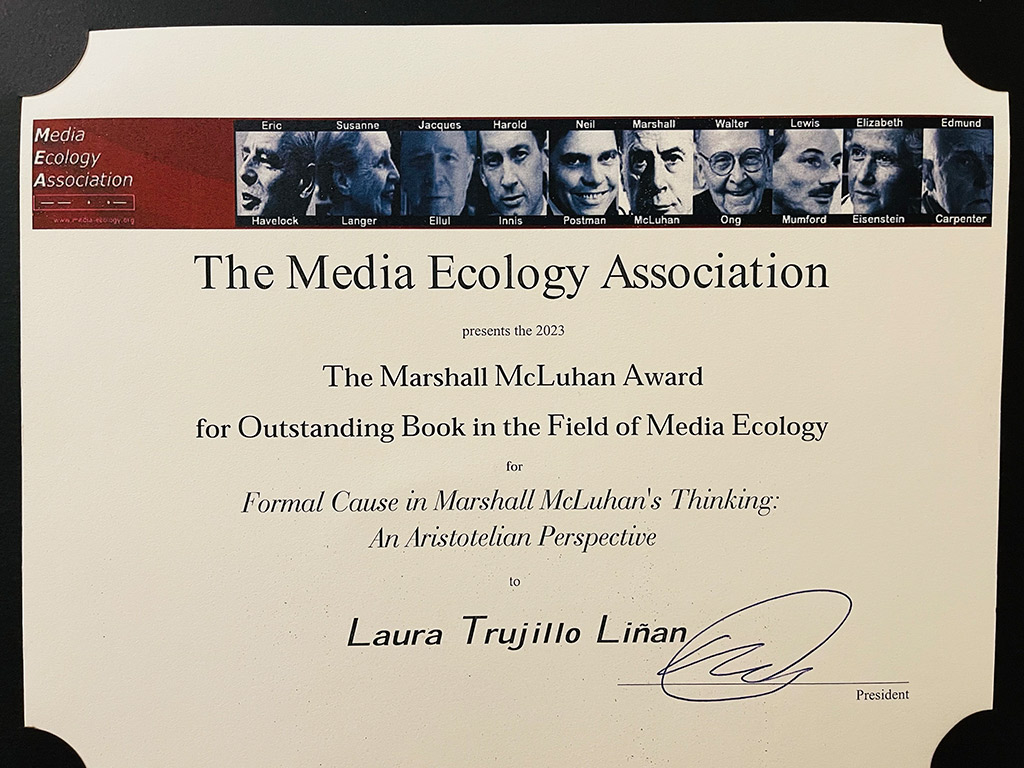
Mexico City, July 14, 2023.— Each year, the Media Ecology Association (MEA) presents a series of awards, including the Marshall McLuhan Award for Outstanding Book, which this year was awarded to the work titled Formal Cause in Marshall McLuhan’s Thinking: An Aristotelian Perspective, written by Dr. Laura Trujillo Liñán, a faculty member at our Universidad Panamericana.
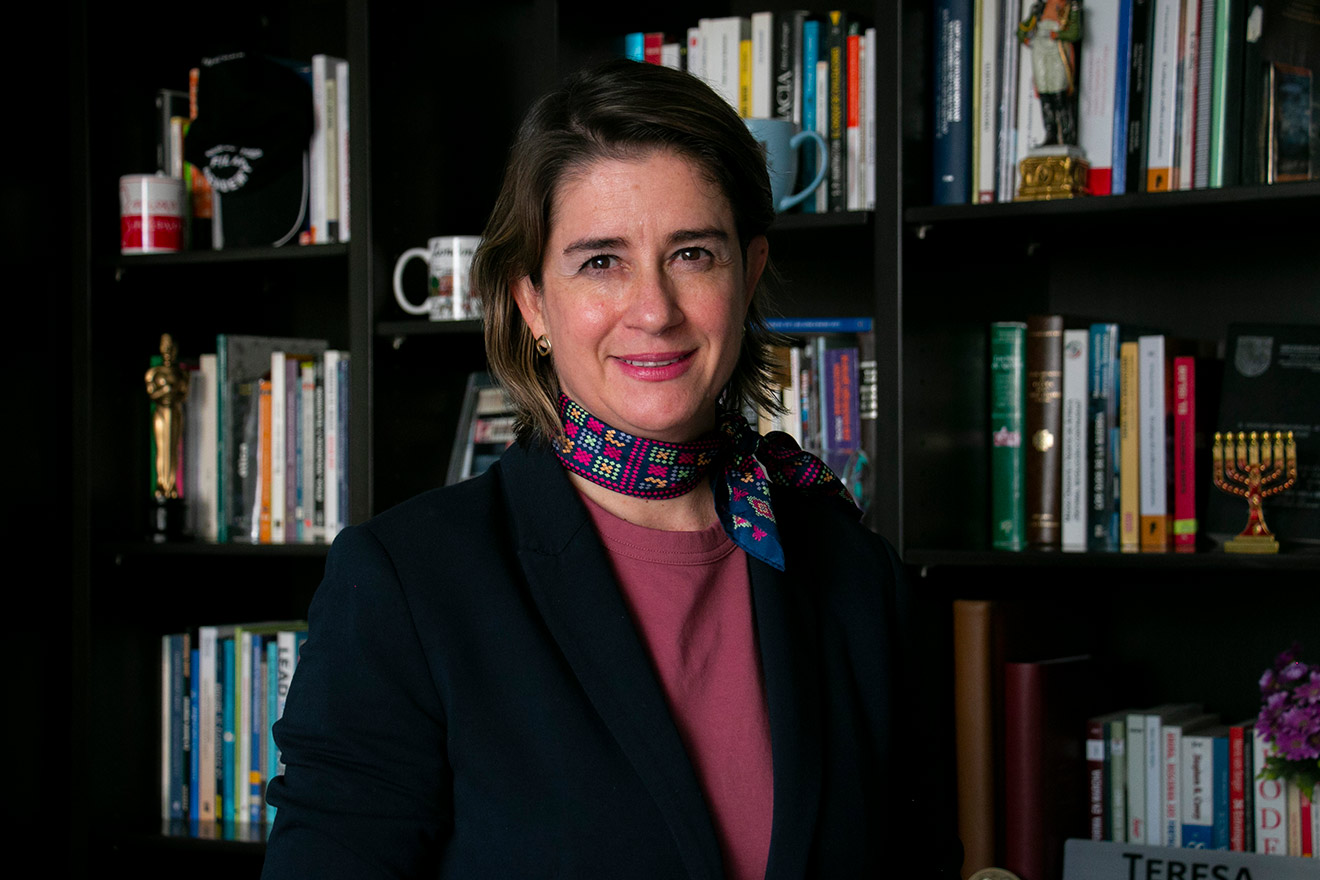
Dr. Laura Trujillo, director of the Open University at our institution. She is also a member of the Humanities Department at the Mexico City campus and a member of CONACYT’s National System of Researchers (SNI Level I), and is a dedicated scholar of Marshall McLuhan.
Formal cause in the context of McLuhan
Marshall McLuhan was a philosopher, scientist, scholar, educator, and communication theorist of the 1960s whose theories revolutionized our understanding of the potential of the media in society.
" The conceptof 'formal cause,'" explains Dr. Trujillo, "is a concept developed by Aristotle, who argued that to better understand reality, one must understand its causes."
The doctor notes that, according to Aristotle, there are four causes: two intrinsic causes—the material cause and the formal cause—and two extrinsic causes—the efficient cause and the final cause. The formal cause refers to the form or essence of a being and determines its nature.
Trujillo also points out that Marshall McLuhan revisits Aristotle’s theory of causality through the interpretations of the French philosophers Jacques Maritain and Étienne Gilson, with whom he had conversations and exchanged letters while they were working together as professors at the University of Toronto.
“Based on these interpretations, McLuhan argued that the formal cause was fundamental to understanding how the media influence, shape, or determine society. According to him, the media are the formal cause of society and play a decisive role in the way people think and act, ” the doctor states.
McLuhan: Essential for Today
“Today, Marshall McLuhan has become an essential author for understanding the impact of social media, the internet, artificial intelligence, and other technologies on our lives. According to him, what we really need to consider in communication is the medium itself—hence his famous phrase, ‘the medium is the message,’” says Dr. Laura.
He also explains:“This means that the content of the message is not as important as the medium through which it is conveyed. Today, we can see how our minds and actions are being shaped by our interaction with the various media we use on a daily basis.”
“This effect is unconscious, which means we’re experiencing changes without even realizing it. Marshall McLuhan was able to foresee this phenomenon long before the internet became as important as it is today,” he adds .
The doctor states that a clear example of this is how the internet has influenced users’ minds, especially among young people, who seek quick and easy gratification due to the nature of the web. “They no longer have the same interest in reading, since it is a slower and more linear process compared to the non-linear nature of the internet, ” she suggests.
Similarly, he confirms that these effects, which McLuhan discussed in his time, have become even more relevant today, as evidenced by works such as *The Shallows: What the Internet Is Doing to Our Brains* by Nicholas Carr and *Infocracy* by Byung-Chul Han, among other texts that address this topic.
Research findings
The doctor explains that, while conducting research for her book, she realized that Marshall McLuhan’s view differs from Aristotle’s. “He refers to the formal cause as something extrinsic to society, whereas for Aristotle, the formal cause is intrinsic and is what determines the being.”
“Finally, I realized that philosophy and communication are deeply intertwined fields, as both are centered on the human being. The former offers a very profound vision and perspective, while the latter is based on dialogue, since, ultimately, human beings and society are shaped through communication,” he says.
Featured Work
For Dr. Trujillo, the fact that her work has received recognition as Outstanding Book in the Field of Media Ecology “represents a significant milestone in my career, as it not only signifies the creation of a text of great relevance to Media Ecology, but also highlights its importance in comparison to other works that competed for the same award in the United States,” she says.
The doctor emphasizes that the creation of this book involved two years of hard work, including research, analysis, and discussions. She particularly highlights the support she received from Lance Strate, a distinguished writer, professor of communication and media studies at Fordham University, and winner of the same award she has now received.
It also acknowledges the support of the Media Ecology Association and the General Semantics Association, which published the book. He also notes that this award has been won by great authors such as Neil Postman and Lance Strate, among others; however, this is the first time it has been awarded to a Latin American author.
“However, what matters most to me is that this recognition doesn’t belong to me alone, but is an achievement shared with my institution, the Universidad Panamericana, as well as with my husband and children, who have been a constant source of support throughout my international career,” she says.
Impact on society
The author argues that *Formal Cause in Marshall McLuhan’s Thinking: An Aristotelian Perspective* establishes a connection between media ecology and philosophy, since philosophy allows for an in-depth analysis of the media and their impact on society.
“Today, media ecology is gaining importance, as studying the relationship between humans and the changes brought about by the media is essential to understanding how technology affects or contributes to people’s development,”he argues.
She points out that organizations such as UNESCO and the UN are expressing concern about the impact of artificial intelligence on society and how it is transforming the way people think and act.
“Today’s jobs will not be the same in the future due to the impact of technologies such as artificial intelligence. (…) Given this dynamic of rapid change, it is crucial to reflect on what our lives will look like in the next 10 years, ”he says.
Working for the good of humanity
These questions are the focus of research at the Media Ecology Association. For this reason, Dr. Trijullo explains that it is imperative for more researchers from various disciplines to join this association and help steer new technologies toward paths that promote the well-being of humanity.
“In this regard, I am already working on new research related to technology and ethics, because, as researchers, we cannot stop working toward a greater goal: leaving a better world for future generations, ”he says.
Media Ecology Association
According to the Media Ecology Association, media ecology is the study of media environments, the idea that technology and techniques, modes of information, and codes of communication play a major role in human affairs.
It is a nonprofit organization dedicated to promoting the study, research, critique, and application of media ecology in educational, industrial, political, civic, social, cultural, and artistic contexts, as well as the open exchange of ideas, information, and research among the association’s members and the broader community.
Researcher's data
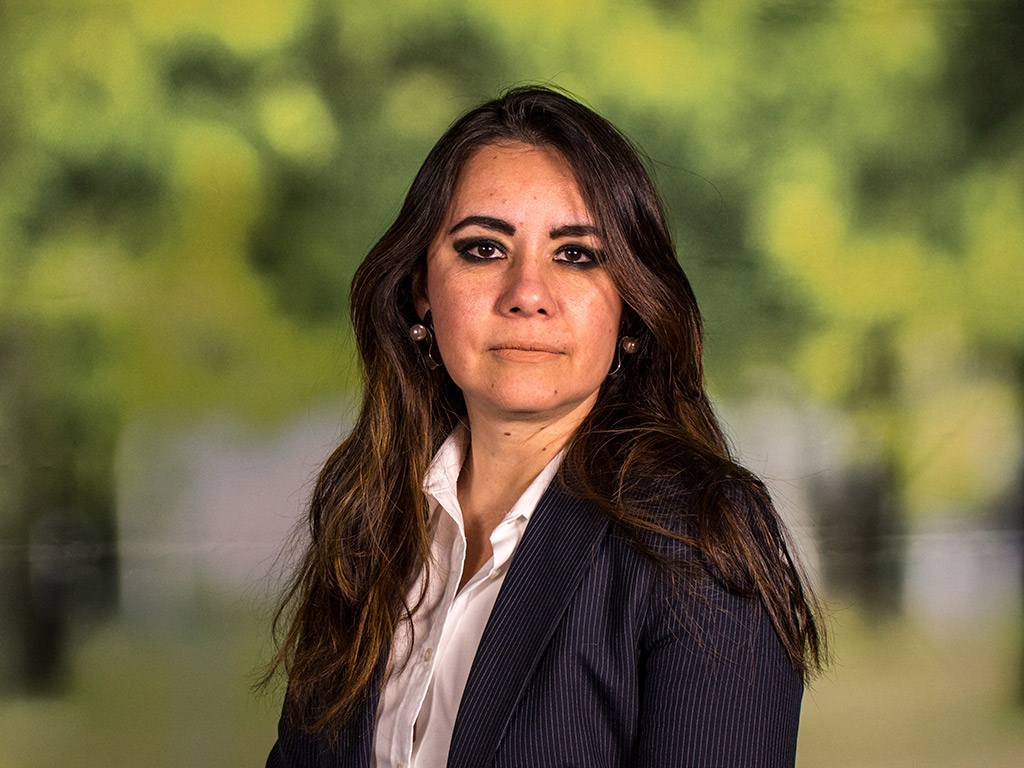
Dr. Laura Trujillo Liñán, SNI Level I.
Director of the Pan-American Open University.
Member of the Humanities Department at the Mexico City campus.