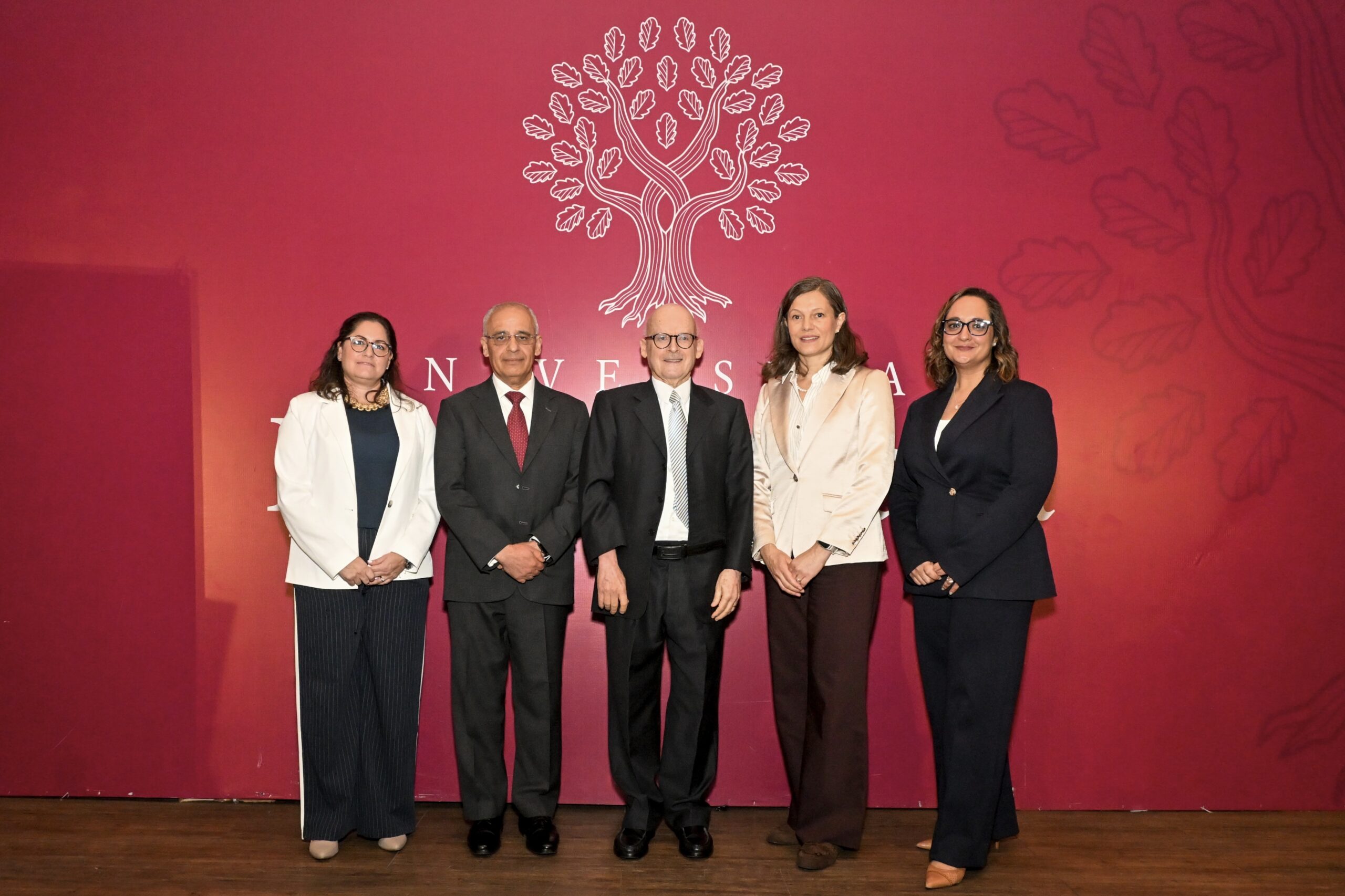
Zapopan, Jalisco; January 13, 2026. — The start of the year presents a challenging outlook for Mexico’s economy. At a press conference held at the Guadalajara campus of the Universidad Panamericana, specialists from the School of Business analyzed the main economic challenges facing Mexico and Jalisco in 2026, addressing key issues such as growth, international tariffs, and the phenomenon of informal employment.
The experts— Dr. Nora Ampudia, Dr. Israel Macías, and Dr. Alejandro Rodríguez—agreed on a common assessment: the country is facing a turning point marked by stagnant economic growth, global trade tensions, and a lack of investment.
The Global Context: Heading Toward a Tariff War?
To understand the local situation, Dr. Alejandro Rodríguez delved deeper into the international analysis. With global growth estimated at just 3%, the resurgence of protectionist policies—especially in the United States—is reshaping the trade landscape.
Dr. Alejandro Rodríguez provided some context on the international landscape, noting that global growth is estimated at just 3%, and that the resurgence of protectionist policies—especially in the United States—is reshaping the trade landscape.

“We are seeing the United States impose tariffs on international trade at a rate even higher than during World War II,” he explained.
The scholar noted that while the tax rate was 9.5% during that war, it now stands at 11%, driven by protectionist policies. This trend is forcing nations to implement urgent structural reforms to avoid losing competitiveness in the face of new forms of trade protectionism.
Mexico and the “tianguization” of its economy
At the national level, Dr. Israel Macías emphasized that inflation remains stagnant due to domestic pressures, new taxes (such as the IEPS), and tariffs of up to 50% imposed by Mexico on Asian products, mainly from China.

One of the most concerning issues, he noted, is the weakening of the formal labor market. Dr. Macías coined the term "tianguización" to describe the current employment dynamics in the country.
“The Mexican economy is becoming like a street market, creating a dynamic that absorbs available labor, but in the informal sector,” he said.
The expert revealed that net job creation in 2025 stood at just 72,000—the lowest figure since the pandemic—which is affecting the real income of Mexican families.
Jalisco: Economic Resilience in the Face of the Challenges of the USMCA
Dr. Nora Ampudia focused her analysis on Jalisco, a state that remains a key economic driver, contributing 7.3% of the national GDP, driven by the electronics and semiconductor sectors. However, its heavy reliance on exports to the United States (80%) makes it vulnerable to potential renegotiations of the USMCA.

“They’re probably going to put a lot of pressure on us to achieve the results Donald Trump wants,” said Dr. Nora Ampudia, even mentioning the possibility that the trilateral agreement could be transformed into bilateral agreements that would put Mexico at a disadvantage.
The scholar also noted that rising labor costs are pushing micro and small businesses into the informal sector. “We are practically in a state of economic stagnation, ” she said, emphasizing that the lack of investment and insecurity are constant obstacles to regional development.
A decade of growth at risk
The "Economic Outlook 2026" press conference organized by the Universidad Panamericana Guadalajara Universidad Panamericana sends a clear warning: without effective policies to promote formal investment and combat insecurity, Mexico could be headed for a lost decade in terms of economic growth.
For the university community, these analyses underscore the importance of financial and business education, which are essential for making strategic decisions in today’s economic climate. Learn more about the School of Economics and Business at Panamericana University at: https://www.up.edu.mx/educacion-universidad-facultad-de-empresariales/