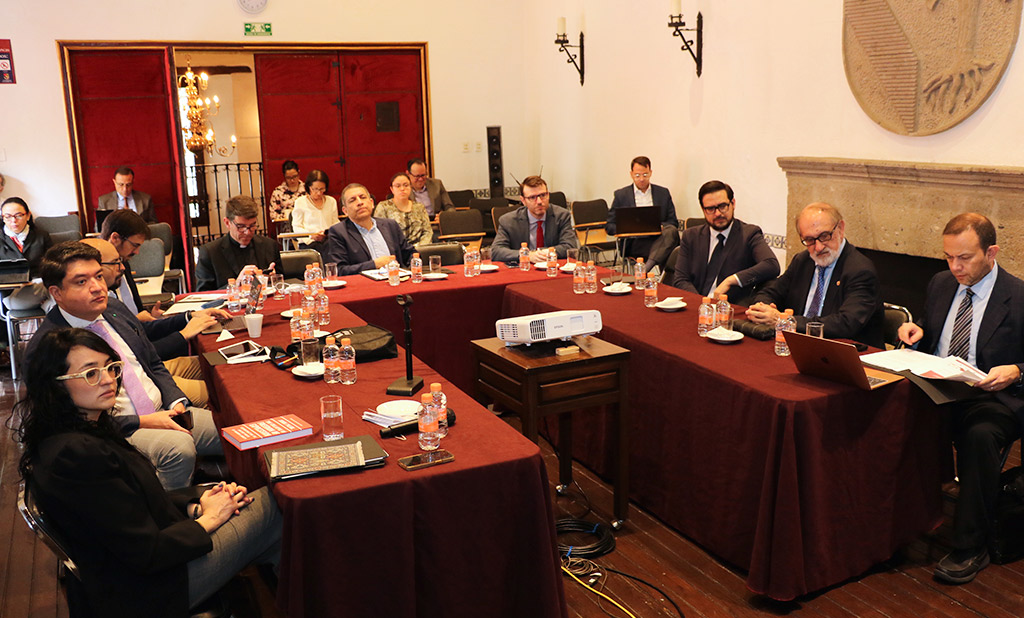
Mexico City, June 5, 2023.- With the aim of discussing the importance of academic freedom for the exercise of university life, the Institute of Humanities of the University of Mexico held the Colloquium on Academic Freedom. Universidad Panamericana held the Colloquium on Academic Freedom.
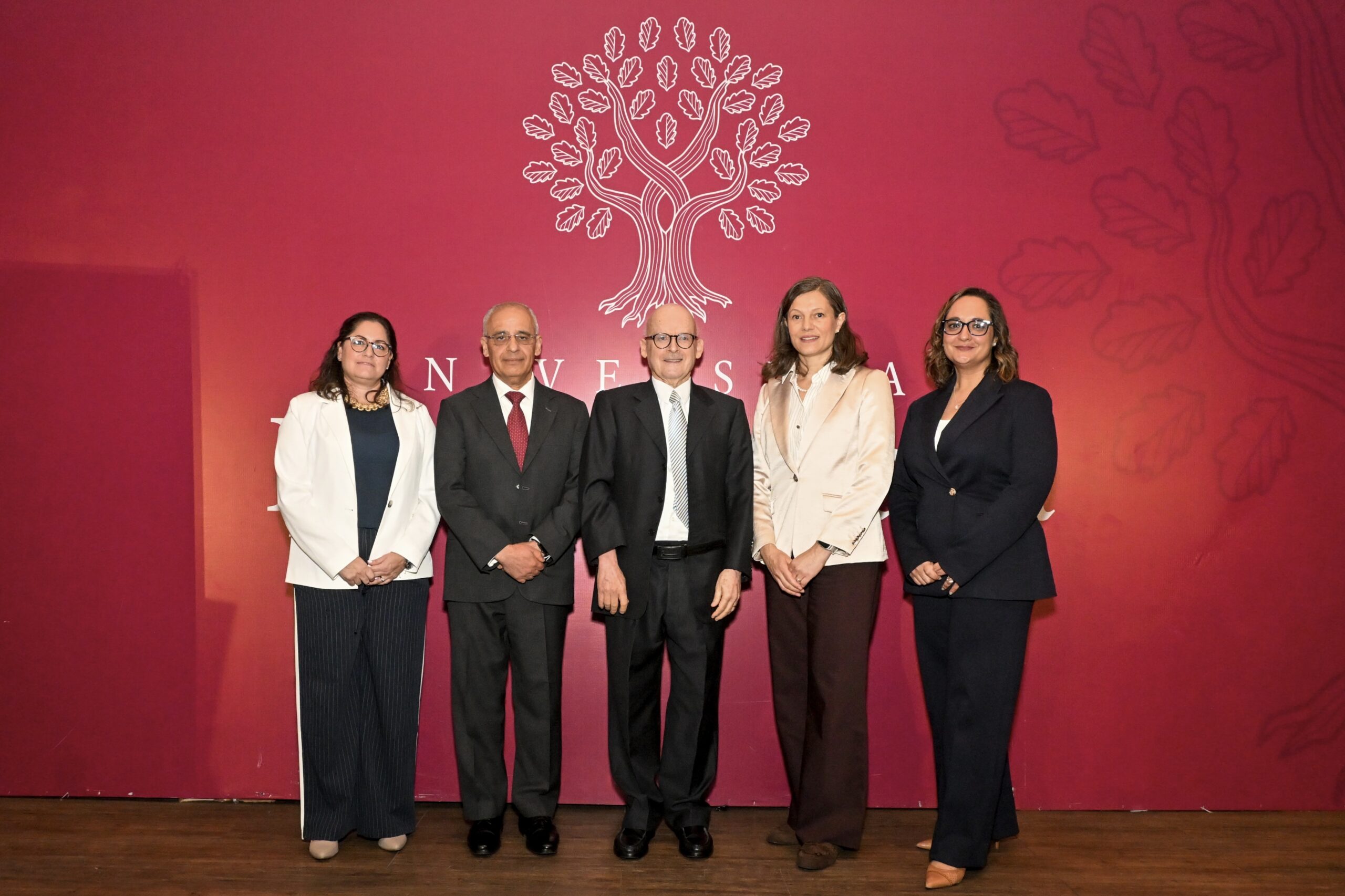
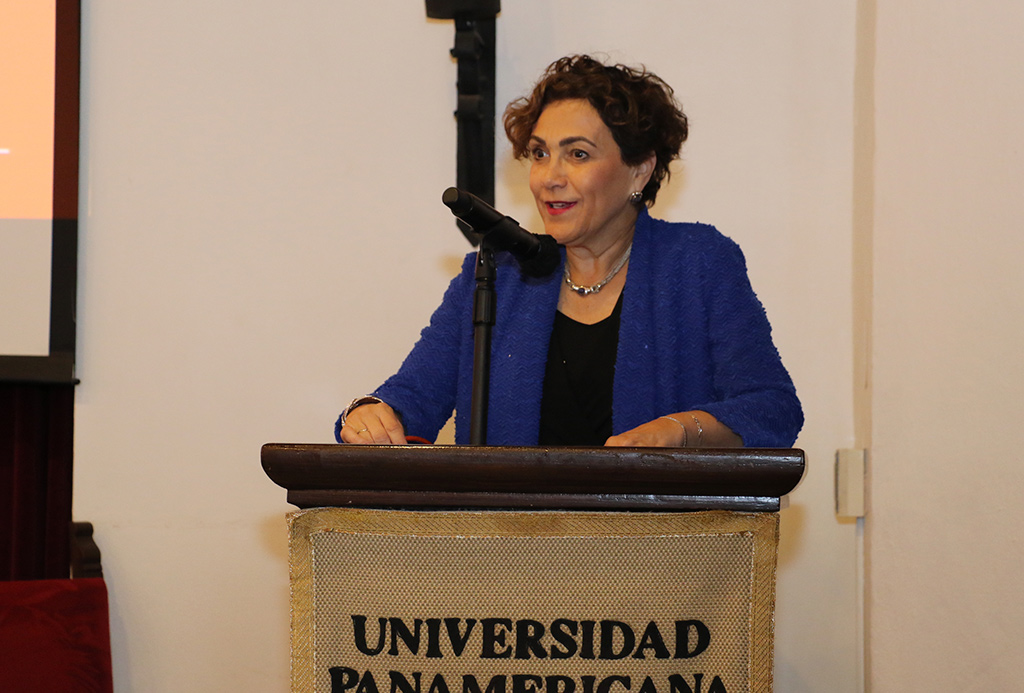
During the inauguration of this event, Dr. Fernanda Llergo Bay, Rector General of Universidad Panamericana and IPADE, said: "This meeting is a manifestation of what the university is all about: dialogue and reflection".
"To speak of dialogue implies rationality, only by using reason can dialogue take place, and by knowing and valuing the dignity of the person can dialogue with openness; because I learn from the other, I listen to the other and perhaps I do not change my way of thinking, but I can enrich it," he said.
University and tradition
During the panel discussion University and Tradition: Academic Freedom as an Essential Note of the University Institution the positive meaning of academic freedom was discussed.
Cecilia Coronado of the Institute of Humanities, defined academic freedom as "a quality that is universally esteemed and promoted, socially and politically for any teaching and research center" .
"There is no doubt that academic freedom is a fundamental right that allows academics and students to express their ideas and opinions, research freely, choose what is taught and learned, and make decisions regarding the management of the educational institution," added
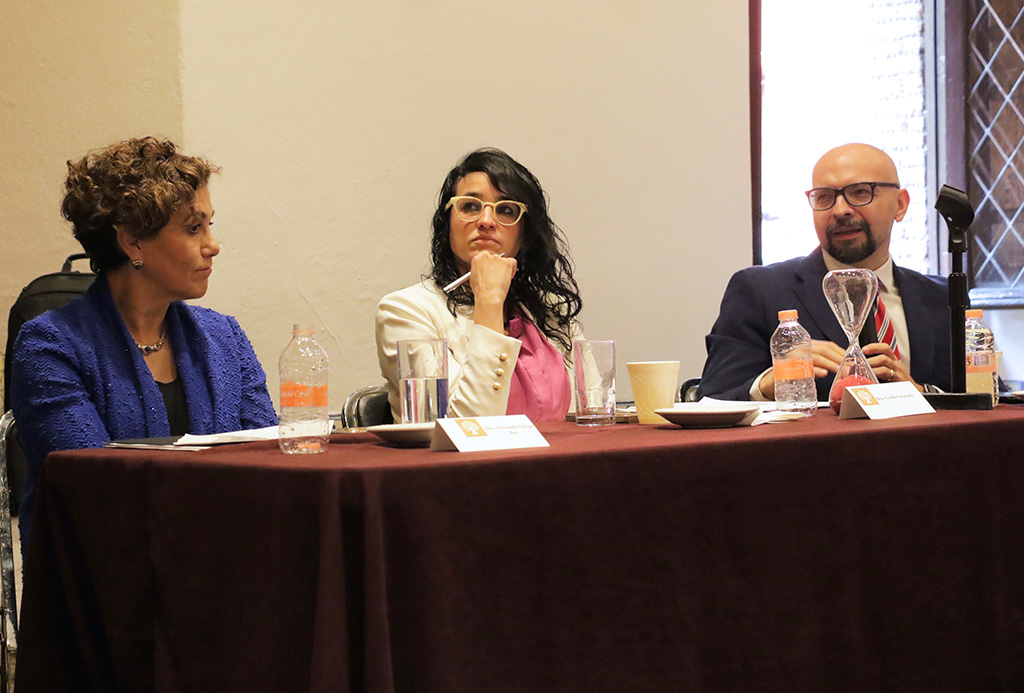
He also indicated that academic freedom: "It is one of the cornerstones of higher education and is essential for the advancement of knowledge and the development of society . Without it, education and teaching will be subject to censorship and external pressure, which could limit the ability of scholars to explore new ideas and perspectives."
Mauricio Dupont, director of Graduate Studies at the Faculty of Philosophy, spoke about the origins of the university in medieval times. About which he pointed out: "The mission of medieval universities is none other than the search, teaching and transmission of truth. This helps us to understand that the university assumes intellectual commitments that affect the way in which teachers and students conduct their academic life".
"The pluralism desired in a society such as ours requires that there be different discourses or ways of seeing the world with claims of truth and that they compete with each other," he said.
"The religious affiliation of a university is not an aberration, as the historical case of the origins of the university institution itself shows, but a condition perfectly in line with the university mission and even desirable for social life. What we must think about is why we have this tension on the table and how to disarticulate it".
Liberalism and university education
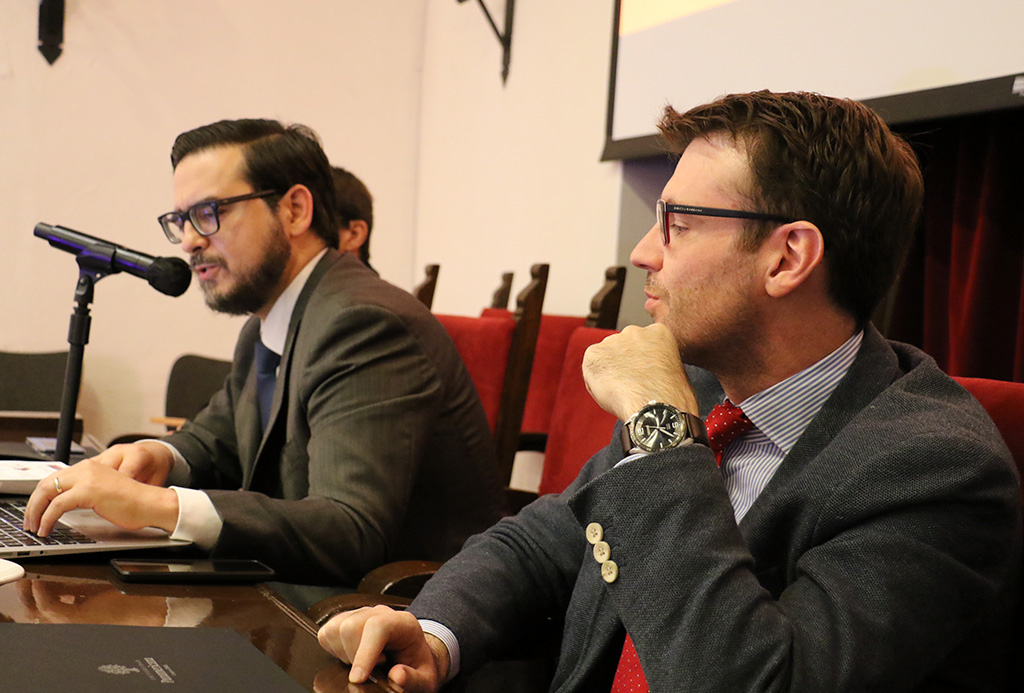
In the panel discussion Are the principles of liberalism compatible with university education?, José María Lloveta research professor at the Institute of Humanities, explained: "We all value academic freedom and are willing to defend it to a certain extent. The debate is about what are the rational limits that should be placed on it and why" .

In this way, he presented a series of arguments why academic freedom is a necessity, among which he highlighted the fact that such freedom, "(...) is fundamental for the progress of science and in general so that our knowledge about the world can be expanded and, once conceived, safeguarded".
He went on to list some of the risks of not restricting such freedom. "The general opinion is that this freedom should be unrestricted, but if it is not limited, it also puts at risk the assets that it is up to him to promote and protect," he said.
In this regard, he pointed out cases of professors who could become charlatans, pseudoscientists, backward, abusive or lazy methods."Academic freedom will serve as a defense against any accusation or criticism."
The importance of dialogue
Later during the same panel discussion, María José García Castillejos, current general director of the high school at Universidad Panamericana, spoke about the academic freedom of the teacher in the classroom, when his or her ideas directly challenge the students, specifically those who feel attacked or offended.
" The binomial of teaching and learning occurs between personalities of all kinds and the examples and speeches used in the classroom could always affect the students for better or worse," he explained.
He then spoke of the so-called safe spaces or "safe places" that nowadays usually exist within universities, which are free of topics that harm political correctness, religious or political opinions, issues of racial or ethnic origins, etc.
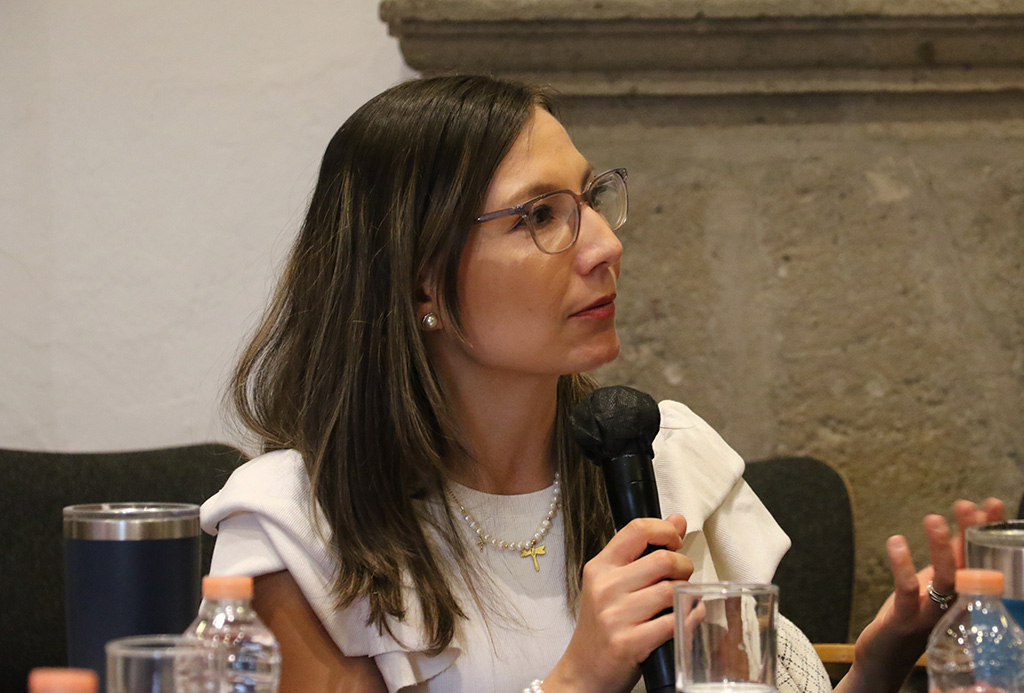
"The university objective is to promote knowledge, not to protect student sensibility. Censoring knowledge or supplanting it with an ideology means that knowledge is no longer knowledge (...)", he stated.
Likewise, he said: "Affections in general, unlike arguments, are individual, since they depend on the subject who experiences them (...). When university education focuses on such particular traits, it is mostly inclined towards the dissemination of opinion, not towards the substantiation of ideas".
"What I am trying to defend is that the teacher must submit his ideas to constant examination and that the texts, many of which have already overcome the experience of censorship, must be read in their context, without trying to update them or tie them to current cultural or social and psychological theories (...)," he said.
In closing, he stated: "(...) to promote authentic reflective thinking, the university professor must reconstruct the arguments instead of taking them for granted or demanding their assent without further ado. One way to achieve this is through dialogue, a quite plausible means to reach the truth".