


Through a rigorous study of primary and secondary sources, the program allows students to trace the genealogy of major philosophical theories and problems, offering them a comprehensive and coherent overview of the most significant answers that the tradition has developed in response to humanity’s fundamental questions.


Doctorate in the History of Thought
The Ph.D. in the History of Thought is designed to train researchers capable of gaining an in-depth understanding of the evolution of the ideas that have shaped Western culture.


Academic Program
The curriculum for the Doctorate in the History of Thought (distance learning track) consists of 10 courses spread over three years; 4 of the courses are methodological and focus on training in research techniques, 4 are seminars on canonical texts in the history of ideas, and 2 courses are dedicated to the development of the thesis proposal.
Curriculum
First Semester
- Source Analysis
- Seminar on Texts from Ancient Civilizations
Second Semester
- Dialectics and Argumentation
- Seminar on Texts from Medieval and Renaissance Culture
Third Semester
- Research Methodology I
- Seminar on Texts of Modern Culture
Fourth Semester
- Research Methodology II
- Seminar on Contemporary Cultural Texts
Fifth Semester
- Thesis Seminar I
Sixth semester
- Thesis Seminar II
PROFILES

INCOME
This program is intended for:
- Individuals with a master's degree from various fields of study who are interested in conducting doctoral research related to the historical, critical, or conceptual study of thought.
- Professionals with experience in humanistic research methods.
- Applicants with sufficient English proficiency to understand specialized academic literature.
- Students who are organized, disciplined, and responsible enough to manage their study and research time independently.
- Applicants with clear argumentative writing skills, critical thinking, advanced reading skills, and a habit of rigorous reflection.

EXIT
What will you achieve by the end of this program?
- A deep understanding of the canonical works of Western thought that will enable you to contextualize and interpret contemporary phenomena with greater clarity.
- To refine advanced methodological skills for the critical analysis of classical sources, conducting specialized research that makes an original contribution to academic discourse and humanistic scholarship.
- To acquire theoretical and practical tools focused on logical analysis and critical reflection, enabling students to understand, question, and interpret culture through active participation in contemporary intellectual discourse.
Advantages
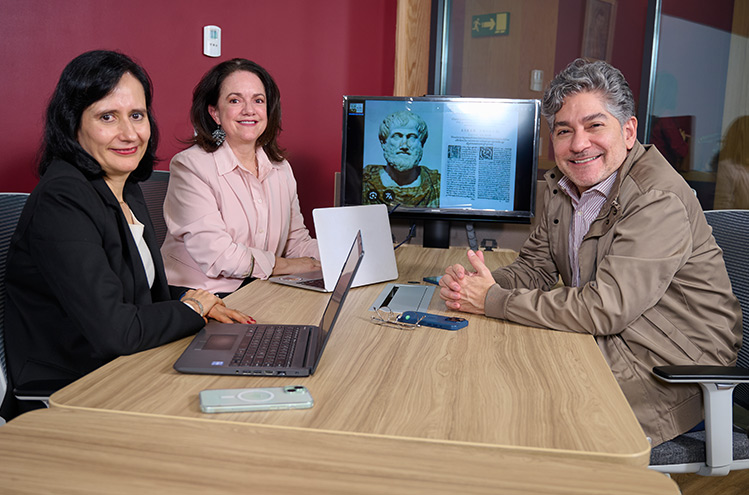
- An academic faculty of excellence composed entirely of researchers with doctoral degrees, the majority of whom are members of the National System of Researchers.
- Academic rigor in humanities research. The doctoral program is distinguished by its emphasis on methodology and critical thinking.
- Supported by and drawing on the prestige of the School of Philosophy at the Universidad Panamericana, which is recognized for its academic rigor, its humanistic tradition, and its commitment to educational excellence.
- A flexible distance-learning program that allows students to balance their doctoral studies with professional and personal commitments.



FREQUENTLY ASKED QUESTIONS
The doctoral program is offered in a non-campus-based (online) format, designed to fit into today’s professional schedule. Synchronous sessions are held via the Zoom platform, lasting 1.5 hours, once a week.
In addition, the program requires between 8 and 9 hours per week of independent study. This time is strictly devoted to the analysis of sources, critical readings, and the systematic progress of the doctoral research project.
The curriculum is structured to be completed in three years (six semesters).
First four semesters: Students take text analysis seminars while conducting research.
Last two semesters: These are devoted exclusively to completing, reviewing, and refining the research for the doctoral dissertation.
Unlike programs that focus on factual, chronological, or purely archival history, this doctoral program takes a philosophical, cultural, and interdisciplinary approach.
Its central focus is the History of Ideas and Intellectual Traditions. The program goes beyond the mere collection of data to focus on the evolution of structures of thought, aligning more closely with intellectual history than with classical historiography.
Yes. The curriculum, which is based on distance learning and a tutorial format, allows doctoral students to balance their professional responsibilities with their advanced studies.
However, it is important to note that the program maintains high academic standards, requiring a constant commitment to in-depth reading and original scholarly work.
No, this graduate program is currently offered independently of the National Graduate Studies System (formerly PNPC).
RVOE AND DATE OF AGREEMENT
RVOE SEP 20254151, dated November 27, 2025. Non-school-based program.
CONTACT
Talib Zamudio Neme, M.A.
Graduate Admissions Coordinator
Email — jtzamudio@up.edu.mx
Phone —
WA: +52 55 4193 8748