

The Master's Program in Ancient Philosophy at the Universidad Panamericana trains researchers who specialize in Greek and Roman philosophical thought and its subsequent reception.

The program combines instruction in Classical Greek with seminars on ancient philosophy, systematic philosophy, and the reception of ancient philosophy.

Over the course of four semesters, each student develops an original thesis under the guidance of a specialist advisor. In addition, students participate each year in extracurricular research activities with national and international faculty and students.

It is the only program in Latin America devoted entirely to ancient philosophy. It operates on a tuition-free basis: all of its students receive a 100% institutional scholarship.
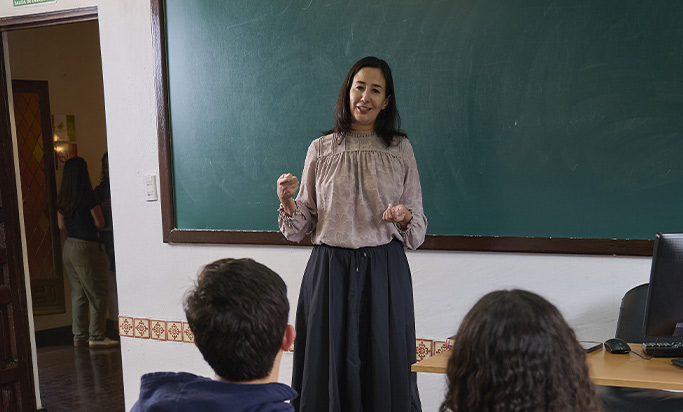

Academic Program

Each semester, this program focuses on a different branch of philosophy on a rotating basis: logic, practical philosophy, philosophy of nature, and metaphysics.

The seminars are taught by faculty members and distinguished international guest researchers.

Curriculum

First Semester

  • Introduction to Classical Greek
  • Selected Topics in Philosophy I
  • Selected Topics in Ancient Philosophy I
  • Selected Topics in Ancient Philosophy I
  • Thesis Advising

Second Semester

  • Classical Greek
  • Selected Topics in Philosophy II
  • Selected Topics in Ancient Philosophy II
  • Selected Topics in Ancient Philosophy II
  • Introduction to Research

Third semester

  • Introduction to the Translation of Greek Texts
  • Selected Topics in Philosophy III
  • Selected Topics in Ancient Philosophy III
  • Selected Topics in Ancient Philosophy III
  • Thesis seminar

Fourth semester

  • Seminar on Translating Greek Texts
  • Selected Topics in Philosophy IV
  • Selected Topics in Ancient Philosophy IV
  • Selected Topics in Ancient Philosophy IV
  • Degree Seminar

PROFILES

INCOME

Knowledge

  • History of Classical Antiquity.
  • Grammar of one or more modern languages.
  • Ancient Philosophers and Philosophical Sources.

Skills

  • Analyze and understand philosophical problems.
  • Write clear and well-organized argumentative essays.
  • To conduct research on topics related to the field of Ancient Philosophy.
  • Manage your time responsibly.
  • Critical and reflective thinking.
  • Strong reading ability with advanced comprehension skills.

Attitudes

  • Openness to dialogue and exchange of ideas.
  • Interest and passion for the study of classical sources.
  • Humility for hard and dedicated study.

EXIT

The Master’s program in Ancient Philosophy will enable graduates to:

To conduct specialized studies in Ancient Philosophy through the use of methodological tools and skills, as well as the analysis of ancient classical texts.

To provide a foundation for an original and holistic perspective on contemporary discussions of the subject, based on a historical review of various classical cultures.

To interpret the characteristics of the reception and uses of Ancient Philosophy within their historical and cultural contexts.

Knowledge

  • Classical Greek for the translation of texts.
  • History of Classical Antiquity, which provides a foundation for understanding contemporary theories.
  • Ancient Philosophy, both in its theoretical aspects and in the characteristics of its practice.
  • The Reception and Use of Ancient Philosophy in Later Philosophical Traditions.
  • Methods for Interpreting Ancient Texts.

Skills

  • Research and analyze documentary sources and topics in Ancient Philosophy.
    Design academic and popular publications on Ancient Philosophy.
    Apply classical doctrines to the study and understanding of contemporary phenomena.
  • Lead and manage multidisciplinary research teams working on projects in Ancient Philosophy.
  • To conduct studies on the reception of ancient philosophy in subsequent philosophical and cultural traditions.
  • To analyze contemporary culture based on an understanding of classical culture.
  • Analyze the classical humanities.

Attitudes

  • Scientific rigor in the study and presentation of the history of the classical philosophers.
  • Research Habits.
  • Intellectual openness to the analysis of the various philosophical positions of antiquity.
  • A Critical Approach to the Study of Classical Authors.
  • An approach that connects contemporary issues with classical perspectives.

Admissions Announcement

The admissions process consists of 4 steps:

1
2
3
4

Application for Candidacy

Applicants must submit their application for admission, supporting documents, academic transcript, and research proposal in accordance with the guidelines provided in the call for applications. These documents will be thoroughly reviewed by the Master’s Program Academic Committee.

Interview

After an initial screening, applicants who advance to the second round will participate in an in-person interview with the program’s Academic Committee. During this interview, the applicant will explain and defend their research proposal and demonstrate knowledge of the secondary literature.

Exam Period

After the interview, candidates who advance to the third round will take two exams. The first is a writing exam, and the second is a text analysis exam.

Ruling

Finally, after reviewing the writing and analysis tests, the board will announce the selected candidates. Once this is done, the registration process will be carried out.

Generation Lines

The Development of Ancient Philosophy in Greece and Rome

  • A systematic study of the philosophical schools and traditions of the Greek and Roman worlds, from the Presocratics to late Neoplatonism. The research is based on a direct analysis of sources in Classical Greek and addresses issues in metaphysics, epistemology, ethics, and cosmology using philological and philosophical methods.

The Reception and Influence of Ancient Philosophy on Later Traditions

  • A study of the processes of transmission, translation, and reworking of Greek philosophical thought in the Latin, Arabic, Jewish, medieval, modern, and Mexican traditions. The research examines both the chain of textual transmission and the philosophical outcomes of each reception within its own cultural context.

Students

Generation
Students
2026–2027
2
2025–2026
5
2024–2025
4
2023–2024
7
2022–2023
4
2021–2022
3
2020–2021
5
2019–2020
7
2018–2019
3
2017–2018
4
2016–2017
4
2015–2016
6
Generation
Thesis Student
Thesis Title
Director
2026–2027
2026–2027
Sebastián Abascal Paniagua
Metaphysical Indeterminacy Based on Aristotle's *Metaphysics*
André Laks
2026–2027
Abraham Magaña Santiago
Platonic solids throughout history. Their understanding and metaphysical relationship to the natural order
André Laks
2025–2026
2025–2026
Emmanuel Aguilar Zavala
Proairesis, a fundamental element of ethical action
Héctor Jesús Zagal Arreguín
2025–2026
Ana Belén Casanueva Ramírez
The Development of the Concept of the Psyche in Plato's Works
André Laks
2025–2026
Misael Jonathan Cruz Alemán
Plato's Critique of Poetry in Book X of *The Republic*
David Lévystone
2025–2026
Hugo Eduardo Chantez Cortés
On the Definition of Kinesis
María Elena García Peláez Cruz
2025–2026
Binnui Navarro Romo
Aristotle's Syllogistics as a Non-Classical Model of Inference
Karen González
2024–2025
2024–2025
Brenda Corina Marín Uribe
A Critique of Nietzsche's Anti-Theological Stance
José María Llovet Abascal
2024–2025
Santiago Quetzalcóatl Rosales Escalera
Challenges in Recognizing the Role of Mediation Under the Law
David Lévystone
2024–2025
María del Carmen Velázquez Zavala
The Emergence of Epistemology in Xenophanes
André Laks
2024–2025
José Talib Zamudio Neme
The Deification or Perfection of the Body
Luis Xavier López Farjeat
2023–2024
2023–2024
Casandra Saraí Freire Muñoz
Implications of Stoic Logic for Seneca's Ethics
David Lévystone
2023–2024
Esteban Flores Martínez
Self-Knowledge in Aristotle
José Alberto Ross Hernández
2023–2024
Ana Paola Gris Trinidad
Human Restoration Through the Liberal Arts
Mauricio Lecón Rosales
2023–2024
Catalina León Letelier
The Reception of Aristotelian Ethics in Duns Scotus
José Luis Rivera Noriega
2023–2024
Erick Palmero Palacios
Philo the Presocratic
André Laks
2023–2024
Víctor Daniel Olivar Ponce de León
The Relationship Between Mythology and Metaphysics
Eduardo Charpenel Elorduy

Scholarships

All applicants admitted to the program receive a scholarship covering 100% of tuition and fees for the entire duration of their studies (excluding graduation costs).

Link

The program has collaboration agreements with Princeton University, the University of São Paulo, the University of Eastern Piedmont, the University of South Bohemia, the University of the Andes, the University of Navarra, and the Institute of Philological Research at UNAM, among other institutions. Graduates are qualified to conduct specialized philosophical research and teach philosophy and classical humanities at the university level.

International Visitors

  1. Stephan Marchand (Sorbonne University, Paris, FR)
  2. Monte Johnson (University of California, U.S.)
  3. Pierre Destrée (UCLouvain, Belgium)
  4. Steven Harvey (Bar-Ilan University, Israel)
  5. Etienne Helmer (University of Puerto Rico)
  6. Xavier Gheerbrant (Sichuan University, China)
  7. Adolfo Roitman (Jerusalem Museum)

FREQUENTLY ASKED QUESTIONS

No. Although interest in these areas is generally universal, this program aims to train high-level researchers in the field of ancient philosophy; for this reason, admission is limited solely to individuals with academic training in one of the three disciplines mentioned.

Because visiting professors are frequently invited to participate, the class schedule may vary each semester. However, the program strives to schedule its seminars and academic activities from Monday through Friday, generally between 10:00 a.m. and 4:00 p.m. This does not mean that classes are held every day or throughout that entire time frame, but rather that, barring exceptional circumstances, sessions are typically held within those hours.

The program is 100% in-person.

This program is offered only at the Mixcoac campus in Mexico City

RVOE AND DATE OF AGREEMENT

RVOE: 20230089, dated August 30, 2024; On-campus program; Augusto Rodin, No. 498, Col. Insurgentes Mixcoac, Zip Code 03920, Benito Juárez, Mexico City

CONTACT

Dr. Mauricio Lecón Rosales

Director of Graduate Studies

Talib Zamudio Neme, M.A.

Graduate Admissions Coordinator