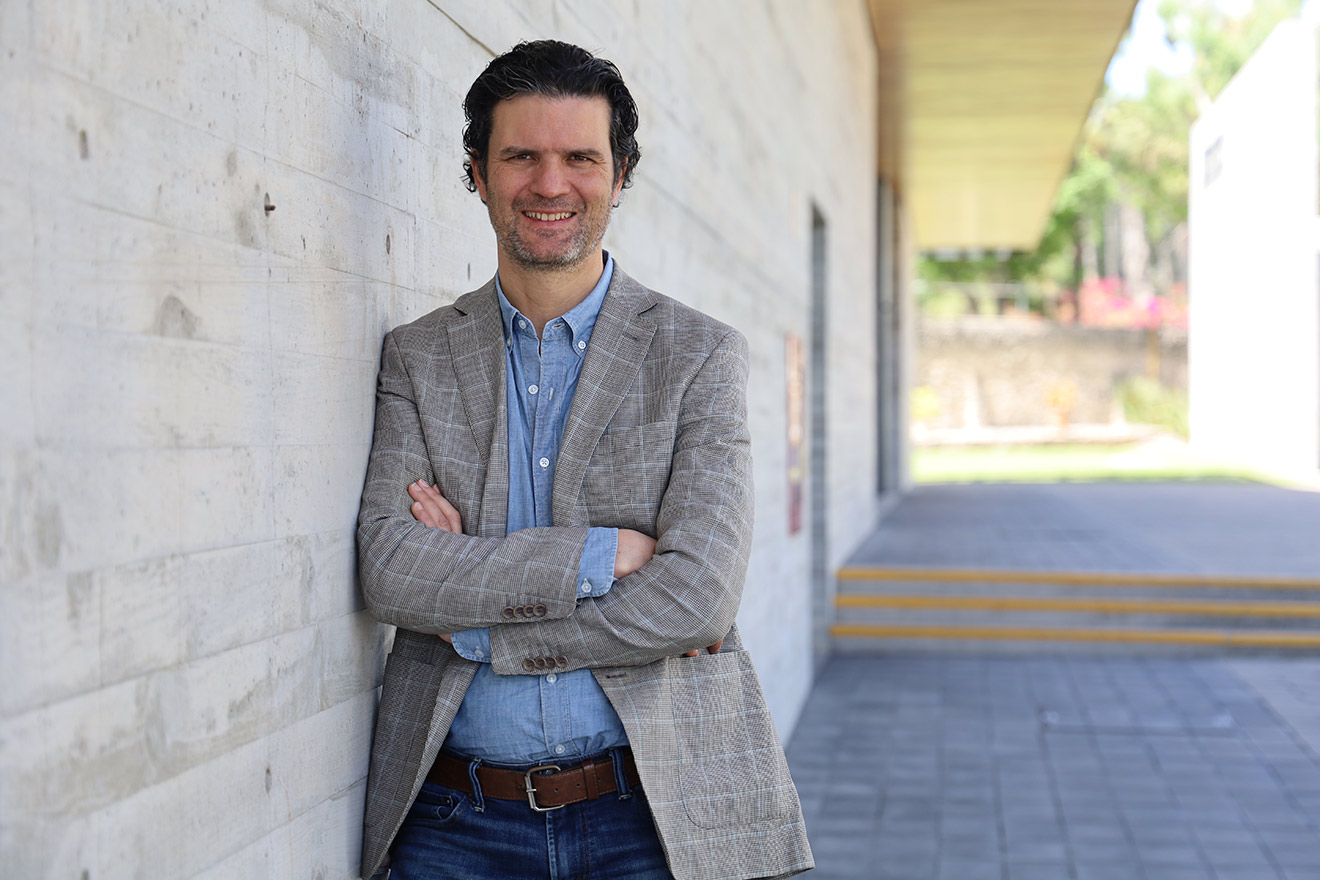
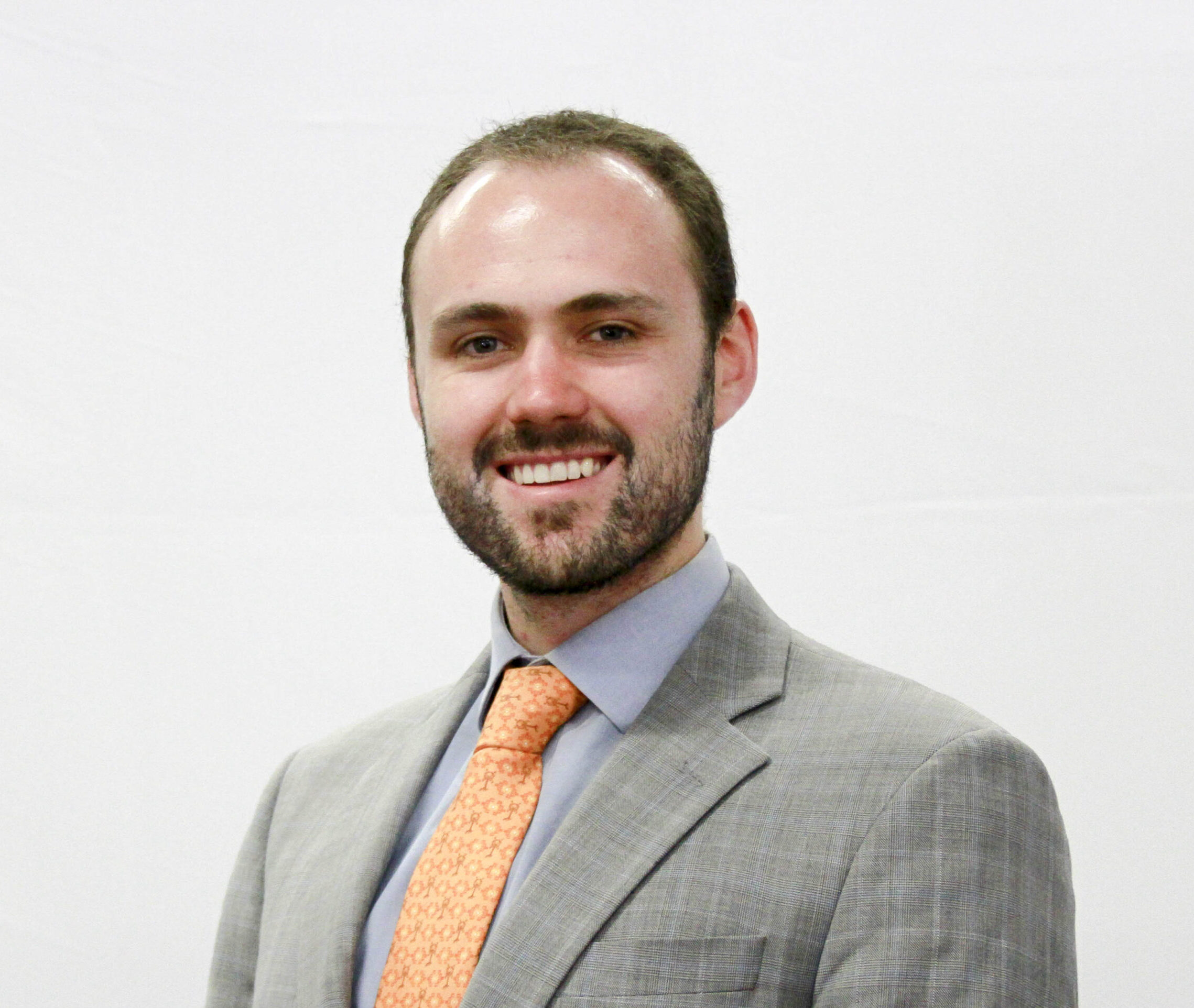
Dr. Salvador Escalante, a research professor at the School of Philosophy at Universidad Panamericana, returns to our institution after five years of academic training abroad.
This was made possible with the support of the Research Immersion Program (REIP) at theUniversidad Panamericana, which enabled him to pursue his doctoral studies at the University of California, Santa Barbara. There, he studied under the supervision of Professor Voula Tsouna, a leading specialist in Platonic and Epicurean philosophy. His academic career also included research stays at Princeton and at the Hardt Foundation in Switzerland.
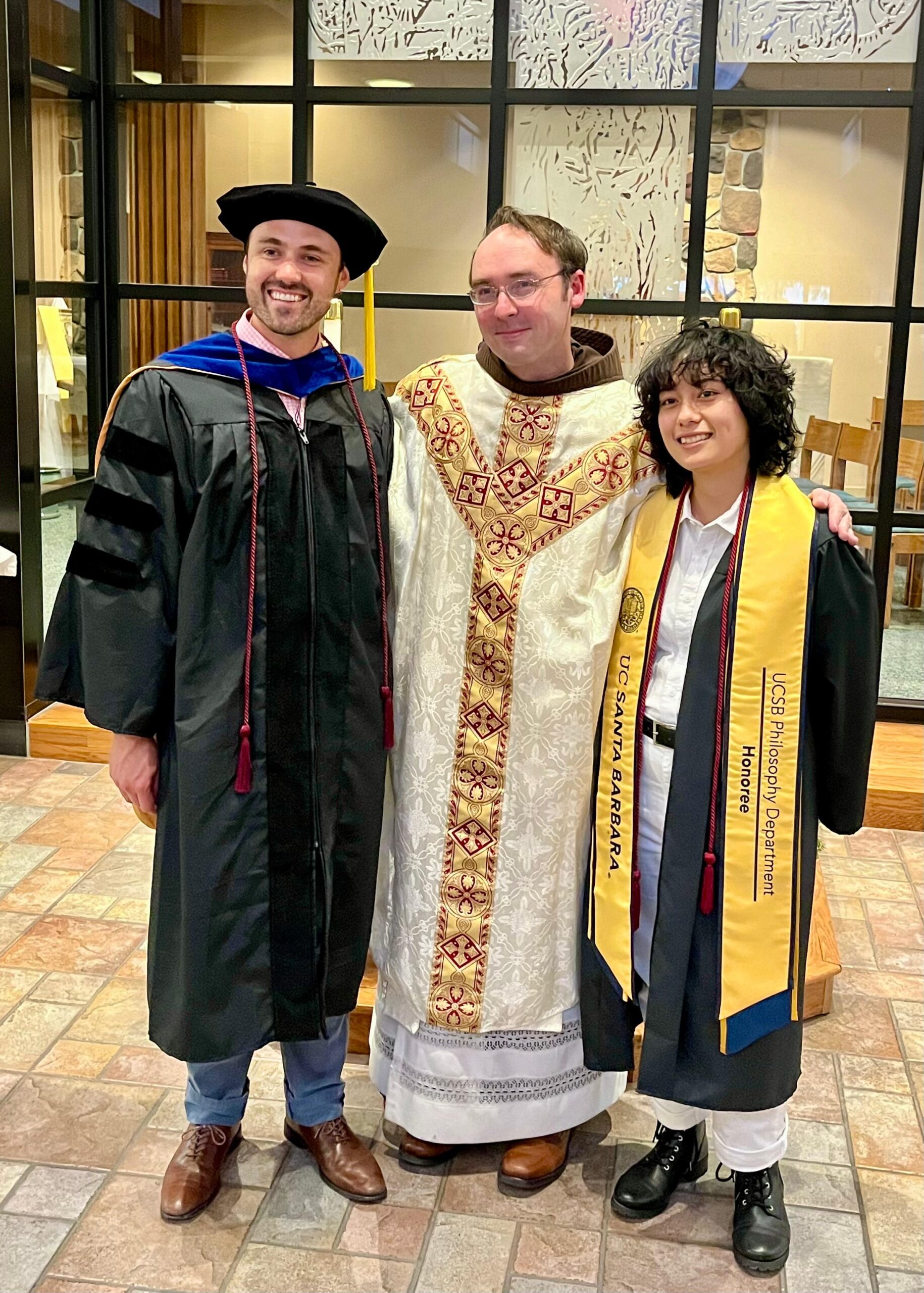
“I am delighted to return to Universidad Panamericana—it truly feels like coming home”, says Dr. Escalante. The scholar highlights positive developments at the institution, including strong support for research and its aspiration to serve as an international benchmark. Beyond the institutional sphere, however, his return has a deeply personal dimension: Mexico City is where he grew up and where his family and friends live, “making the opportunity to build a career here truly invaluable”, he affirms.
Between Homer and Plato: An Inquiry into Who We Are
Dr. Escalante’s doctoral project began with a core conviction: “We owe a debt to Greek culture unlike any other”. Plato, he notes, is, alongside Aristotle, the most influential of the Greek philosophers, and the works of Homer form his primary intellectual backdrop.
The question guiding his research was as ambitious as it was fundamental: What is the history of our conceptions of our identity as persons, and how is this history intertwined with the history of conceptions of the soul? To answer this question, Escalante examined two pivotal moments in that history: Homer and Plato.
His central thesis challenges the prevailing scholarly consensus. He explains that although neither Homer nor Plato had a term equivalent to “person” or “personal identity,” most interpreters have assumed that either they lacked any conception of personal identity at all, or else they held a conception according to which the person is identical with the soul.
Dr. Escalante proposes an alternative interpretation: “Homer and, especially, Plato did indeed have a conception of personal identity, and according to this conception, a person is not their soul.”
The Value of an Expert Perspective
Reflecting on the role of his doctoral advisor, Professor Voula Tsouna, Dr. Escalante highlights her deep understanding of Greek culture, which enabled her to point out key counterexamples that helped refine his arguments. One of the most significant of these involved a central claim in his dissertation: the idea that “inner life” is an inadequate term for describing the psychology of Homeric characters.
Tsouna drew his attention to passages in the Iliad and the Odyssey that seemed to show signs of interiority (such as when Achilles realizes that Odysseus is trying to persuade him to return to the battlefield), prompting Escalante to qualify his position: Homeric heroes do possess psychological elements that we would associate with an inner life.
“Yet they themselves did not conceive of these psychological elements in that way, as they drew no distinction between an inner life situated in a private sphere inaccessible to others and the external world surrounding them,” he states. This, he explains, stems in part from the fact that the ancient Greeks did not separate the corporeal from the mental: “for them, even emotions had a body”.
Through this example, Dr. Escalante illustrates how his advisor’s holistic vision enabled her “to delve into the finer details of my arguments without losing sight of the bigger picture of which they were a part.”
Three Spaces, Three Lessons
In addition to Santa Barbara, Dr. Escalante completed research stays at Princeton and at the Hardt Foundation in Switzerland—two institutions with markedly different characteristics.
The Hardt Foundation is dedicated to promoting the study of classical antiquity and fostering dialogue as a means of mutual understanding.
For Escalante, this experience provided exposure to diverse approaches to conducting research and engaging with the philosophical tradition: “Our questions build bridges that foster mutual understanding, despite our historical, political, and ideological differences”.
Regarding Princeton, Escalante remarks: ““Perhaps the most iconic institutions in Princeton are Small World Coffee, a café, and Labyrinth Books, a bookstore. Together, they embody thepassion for dialogue and knowledge that defines this small town.”
Comparing the two academic traditions, Escalante observes that Europe places greater emphasis on immersing itself in historical context, whereas the United States prioritizes conceptual clarity and argumentative rigor. “I believe th Universidad Panamericana s embodies both components, yet seeing them distilled separately helped me appreciate their distinct value”, he reflects.
What Lies Ahead
Upon his return, one of Dr. Escalante’s primary goals is to continue publishing the findings of his doctoral research and to participate in collaborative projects—potentially focused on moral psychology, the relationship between the individual and the community, or the reception of ancient philosophy.
Likewise, in his teaching, he aims to introduce students to new research methodologies and instill in them “the importance of clarity of ideas and transparency in argumentation.”
Why Keep Reading Homer and Plato?
For the researcher, the enduring relevance of these authors is far from merely historical. He recalls that in Book IX of the *Iliad*, Achilles questions the meaning of all his actions up to that point, raising a question every human being must answer for themselves: What is the meaning of my life? Plato took up that inquiry when he famously declared that the unexamined life is not worth living. Since then, thinkers such as Friedrich Nietzsche, Viktor Frankl, and even Pope Francis have offered distinct responses.
“Studying this history allows us to see that Achilles’ question arose within a context of personal and social crisis,” he explains, referring to Agamemnon’s betrayal of Achilles and the impending defeat of the Greek army. He adds: “(…) it shows us that by asking this question, we are searching for a value capable of withstanding such moments of crisis”.
For Escalante, contemporary philosophical questions become superficial when posed without historical perspective: “Reading Homer and Plato reminds us of pivotal moments in this intellectual trajectory, thereby restoring historical depth to our inquiries.”
Advice for Those Who Want to Study Abroad
Drawing on his own experience, Dr. Escalante believes that pursuing graduate studies or research stays abroad can be an immensely rewarding academic experience, although one that comes with significant challenges.
He therefore recommends drawing on the experience of peers who have gone through similar processes in different countries, researching how to prepare a competitive application, and, once abroad, prioritizing personal well-being alongside academic commitments.
“For faculty and staff at Universidad Panamericana, the opportunity to participate in REIP is invaluable, as it makes it possible to apply to institutions one could otherwise only dream of attending”, he concludes.
Learn more about research projects at the Universidad Panamericana at: https://www.up.edu.mx/investigacion/noticias/