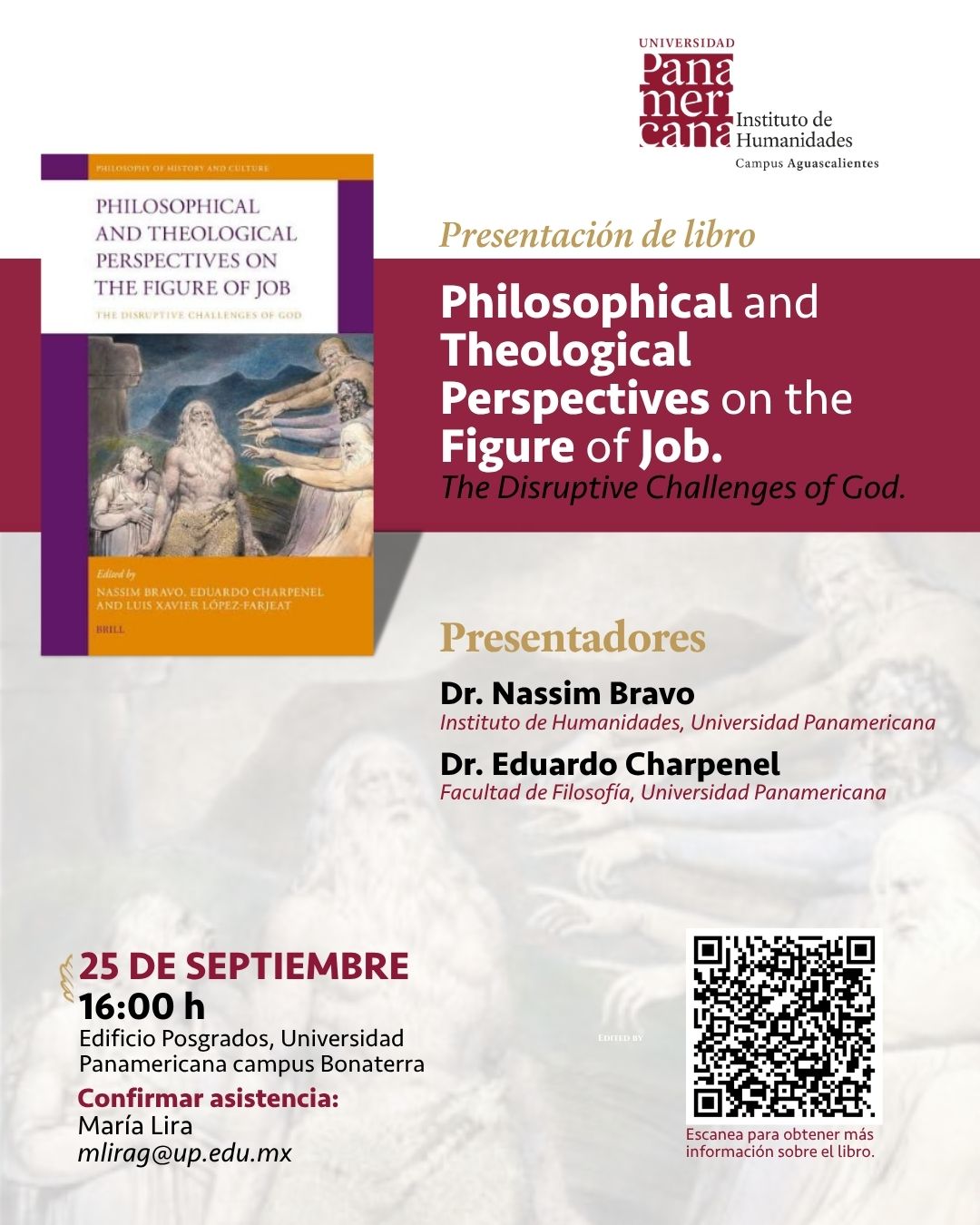
The biblical figure of Job—the righteous man who loses everything for no apparent reason—has been at the heart of humanity’s most profound questions about suffering, justice, and the relationship between human beings and the divine for centuries.
Now, a new scholarly volume published by Brill, Philosophical and Theological Perspectives on the Figure of Job: The Disruptive Challenges of God, brings together specialists from diverse philosophical and religious traditions to explore—without attempting to rule out—the tensions that this narrative continues to raise today.
The book, Volume 41 in the series Philosophy of History and Culture, was co-edited by Dr. Nassim Bravo Jordán, Dr. Eduardo Charpenel Elorduy, and Dr. Luis Xavier López-Farjeat, scholars at Universidad Panamericana.

A Figure Who Transcends a Single Tradition
For Dr. Bravo Jordán, the starting point was recognizing that the story of Job does not belong exclusively to the Christian interpretation with which it is typically associated. “The story of Job is a classic narrative that has had an impact across multiple traditions throughout history,”, he explains.
He further notes that because the themes it raises—the origin of suffering, justice, and the relationship with the divine—still challenge us today, the editorial team decided to approach it “from multiple perspectives that would enrich our understanding of these enduring questions”.
This commitment to plurality explains much of the volume’s structure, which places Job in dialogue with Kant, Kierkegaard, and René Girard’s mimetic theory, while also engaging María Zambrano’s poetic reason, Islamic theology (kalām), and artistic representations such as William Blake’s illustrations.
Why Job Remains Unsettling
One of the central themes of the book is Job’s subversive nature in relation to conventional notions of justice. Dr. Bravo Jordán explains this through the lens of the original Hebrew worldview: a “simple and intuitive, yet problematic” theory according to which “good people are rewarded and enjoy life, whereas wicked people are punished and suffer”. The problem, he points out, is that lived experience constantly contradicts that framework.
He adds that in today’s world “accustomed to getting answers quickly, the catastrophes endured by Job—who stands as the paradigm of the righteous man—remind us that the question of justice in the world is never easily answered” and compel us to live with uncertainty.
Philosophy, Mysticism, and Islam: Three Distinct Perspectives
What does reading Job alongside modern philosophers contribute that a purely theological analysis would not? For Dr. Bravo Jordán, its value lies in demonstrating that the narrative’s message “cannot be reduced to a religious or confessional discourse […], but is rather universal.”
The inclusion of María Zambrano stems from a similar impulse, albeit from a different tradition. In contrast to the Western tendency to resolve human questions through abstract concepts, Dr. Bravo explains that Zambrano’s Hispanic approach “suggests that there are dimensions of existence that cannot be reduced to a concept or theory”, but must instead be grasped “from the innermost core (‘entraña’) […] and through poetic discourse”.
By incorporating the Islamic perspective, he states, we address a pressing need of our time: “In a context in which non-Western worldviews often seem foreign, incomprehensible, and even threatening, it is essential to examine how Muslim scholars have grappled” with questions similar to those posed by Job.
An Open-Ended Question With No Conclusion
The analysis of Job does not seek to offer a definitive answer to the problem of suffering. For Dr. Bravo Jordán, there may be multiple answers, and certain questions may rightly remain unresolved.
This openness is one of the central pillars of the book: in contrast to a contemporary mindset accustomed to seeking quick answers, Job keeps the inquiry into justice in the world and the meaning of suffering open.
Similarly, he notes that bringing together specialists from such diverse traditions was not without its challenges. “The main challenge is offering them full support to express their ideas freely, while simultaneously convincing them that we are all contributing toward a shared goal,”, he remarks.
He acknowledges that among the contributors there are views that “one might argue represent opposing positions; yet all form part of the same intellectual project”.
What He Hopes Readers Will Take Away
For non-specialist readers picking up this volume, Dr. Bravo Jordán hopes the book will spark an interest in reading the Book of Job for themselves and discovering the enduring relevance of the questions it raises.
In addition, he hopes they will discover that questions posed centuries ago “are not so far removed from what readers themselves experience in the modern world”.
Further details on the book *Philosophical and Theological Perspectives on the Figure of Job: The Disruptive Challenges of God* can be found here.
Learn more about research projects at the Universidad Panamericana at: https://www.up.edu.mx/investigacion/noticias/